
Next-Gen Custom Software: Trends for 2026 and Beyond
|
As the calendar turns a new leaf, the industry of custom software is ready to enter its most defining era. In a rapidly growing industry, factors such as increasing business complexities, rising customer demands, and tighter regulatory environments continue to fuel its expansion at breakneck speed.
Hence, it is no surprise that generic tools seem to be losing the tech race. Off-the-shelf solutions are no longer enough for Canadian businesses, and that is evident from the influx of investment sectors such as digital transformation, AI, and cloud infrastructure seem to be receiving.
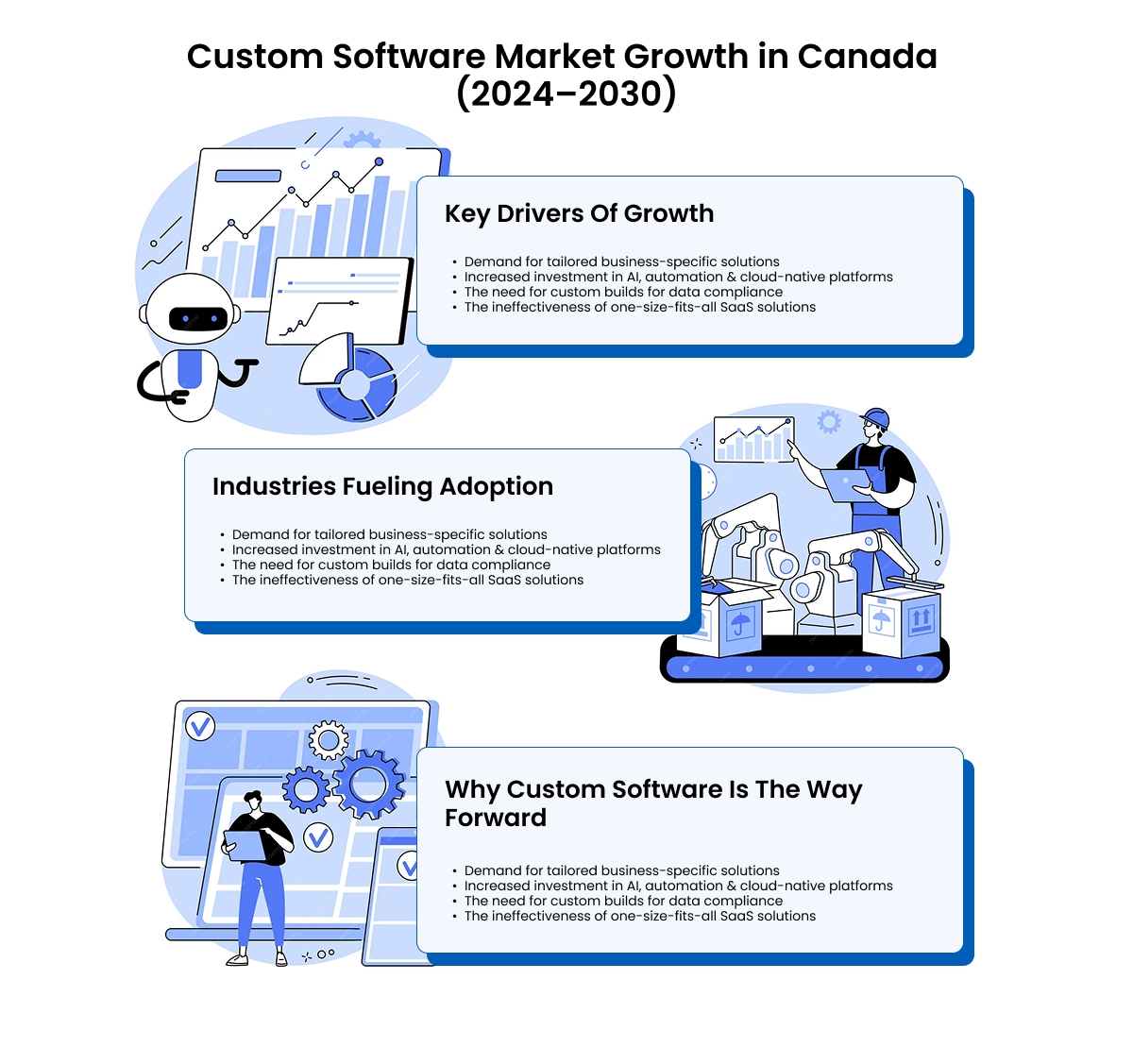
Businesses want software built around their needs and that is where the tide is shifting in 2026. In fact, reports show that the Canadian custom software development market is expected to hit a revenue of US$9,891.2 million by the year 2030. There’s simply no sign of slowing down!
In this blog, Vestra Inet – the leading developer of custom software solutions in Ontario – will turn the spotlight on trends set to take over 2026, helping business leaders and IT managers such as yourself prepare strategically for what’s next.
Trend 1 – AI, Machine Learning & Automation
Probably the biggest trend that keeps blowing up is Artificial Intelligence. But what’s different this year is that AI is no longer an experimental addition to custom software. It is now a part of the foundation, and that means the way applications behave, learn, and optimize is changing.
Intelligent automation in custom applications
Rule-based automation is slowly turning into a thing of the past. Modern AI-based systems are dynamic in nature and are capable of interpreting patterns, predicting outcomes, and adjusting processes on the fly.
While service providers can use this to optimize resource allocations and pricing recommendations, manufacturers can automate their production scheduling based on real-time constraints. AI is not just a fad anymore, it is a weapon of efficiency for Canadian businesses.
Predictive analytics embedded in workflows
Newer versions of custom software do not analyze data after the fact. Instead, they make predictive analytics a core part of operational workflows so you can get access to demand forecasts, flagged risks, and recommended actions in real-time. The result? A proactive workflow with shorter decision cycles.
Is AI only for large enterprises?
We would be lying if we said AI in custom software development is a feature only the titans of the industry can use to their advantage. That’s an outdated notion. New advancements in the realm of cloud infrastructure, modular AI models, and scalable architecture means mid-sized businesses can now access AI-based custom software too. In fact, you have the flexibility to apply AI selectively, which means you can restrict it to high-impact use cases and save a ton of money!
Trend 2 – Low-Code / No-Code Software
Low-code custom application trends are here to stay. You can expect to see more and more apps built on low to no-code platforms, making them easier to maintain in the long run. In fact, in 2026, such apps will be the foundation for all sorts of internal applications, workflow automation, and rapid prototyping.
Democratizing custom software creation
If you want end-users to participate in the development process, low-code platforms are a great way to go. They allow “citizen developers” to make a direct contribution to the building of an application with the help of visual aids and preconfigured components.
Think of it as a tool that empowers a business like yours to quickly deploy internal tools without waiting through a full development cycle. Combine this with custom software, and you can modify the modules of the tools you use without calling in vendor support.
Balancing speed with enterprise-grade needs
The world of business is spinning faster than it ever used to and you need tools that can match its pace. Low-code solutions bring breakneck speed to the table but only when they are used cautiously. The most strategic approach is to use custom-built architecture – especially if you want security and performance you can scale.
You can also adopt a hybrid approach, i.e., use low-code software for extensions while building a custom-built core to ensure long-term stability.
Does a low-code platform compromise scalability or security?
Well, it depends. If you just use a low-code system without backing it up with a solid custom software development solution, then yes, it compromises both. However, with the strict IT standards, role-based access, and secure integrations that custom software provides, it becomes a powerful accelerator rather than a limiting and risky tool.
Trend 3 – Cloud-Native Architectures & Multi-Cloud Strategies
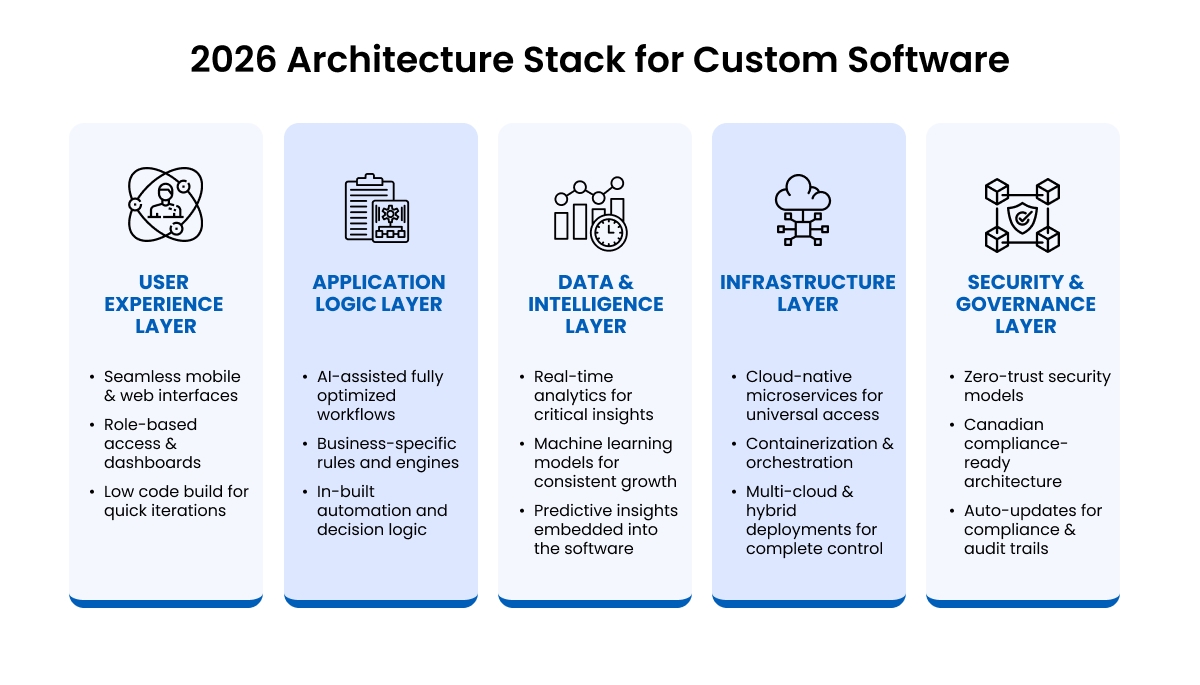
The year 2026 will likely witness cloud-native design becoming the default for custom software development. Modern solutions won’t use the cloud simply as a hosting platform. Instead the entire system will be rebuilt from the ground-up in a cloud-native framework to be more scalable, resilient, and flexible.
Building for scale, agility, and global reach
Cloud-native architecture is built for effortless sustainability. By using microservices, APIs, and containerization, modular systems can be created, which can be individually scaled if that is what your business needs.
Plus, since you can release features faster and isolate failure, you are better equipped to adapt to your company’s evolving state. A complete win-win for growing organizations – especially those spread out across multiple locations.
Canadian data sovereignty and compliance considerations
Canadian businesses are in luck. The country has data residency and regulatory requirements for cloud-native custom software, which means you do not have to worry about losing sensitive data. Whether you opt for a multi-cloud or a hybrid-cloud model, with custom software you get the flexibility to balance performance with compliance while leveraging global cloud services when you need to.
Is legacy migration still worth it?
It is now more worth than it has ever been but only if you migrate judiciously. You do not have to opt for a full rewrite of your company’s entire existing software. A wiser approach is to modernize your legacy system incrementally with the help of APIs. That way you can migrate high-impact processes to a cloud-native structure first while bypassing associated risks.
Trend 4 – Sustainability, Ethical Tech & Digital Responsibility
The emphasis on sustainable tech is only increasing and it’s making its way to custom software development solutions too. Far from a branding exercise, most major organizations will consider their software’s environmental footprint, ethical data use, and long-term societal impact as a core part of its performance.
Green software engineering and energy-aware design
Since sustainability is gaining momentum, you need to now partner with vendors who are capable of offering you energy-efficient cloud services. The good thing is modern development teams, like the one we have at Vestra Inet, are capable of designing advanced applications that consume fewer resources and scale dynamically when needed, thus optimizing resource use based on demand. It’s a great way to bring about cost reductions.
Ethical AI, piracy, and data governance in Canada
For Canadian businesses like yours, concern around the ethical use of AI in custom software is justified. Maintaining data privacy, algorithmic transparency, and consent management are essential. Fortunately, responsible software design offers governable AI models with clear audit trails and strong regulatory frameworks so your company can stay compliant.
Is sustainability just a buzzword?
It is natural to want to dismiss sustainability as another emerging custom software trend that doesn’t hold. But sustainability is here to stay. Your business’ commitment to sustainability – even in its choice of software – signifies brand trust and regulatory compliance, which is what your customers want.
Trend 5 – Edge Computing, IoT, & Real-Time Systems
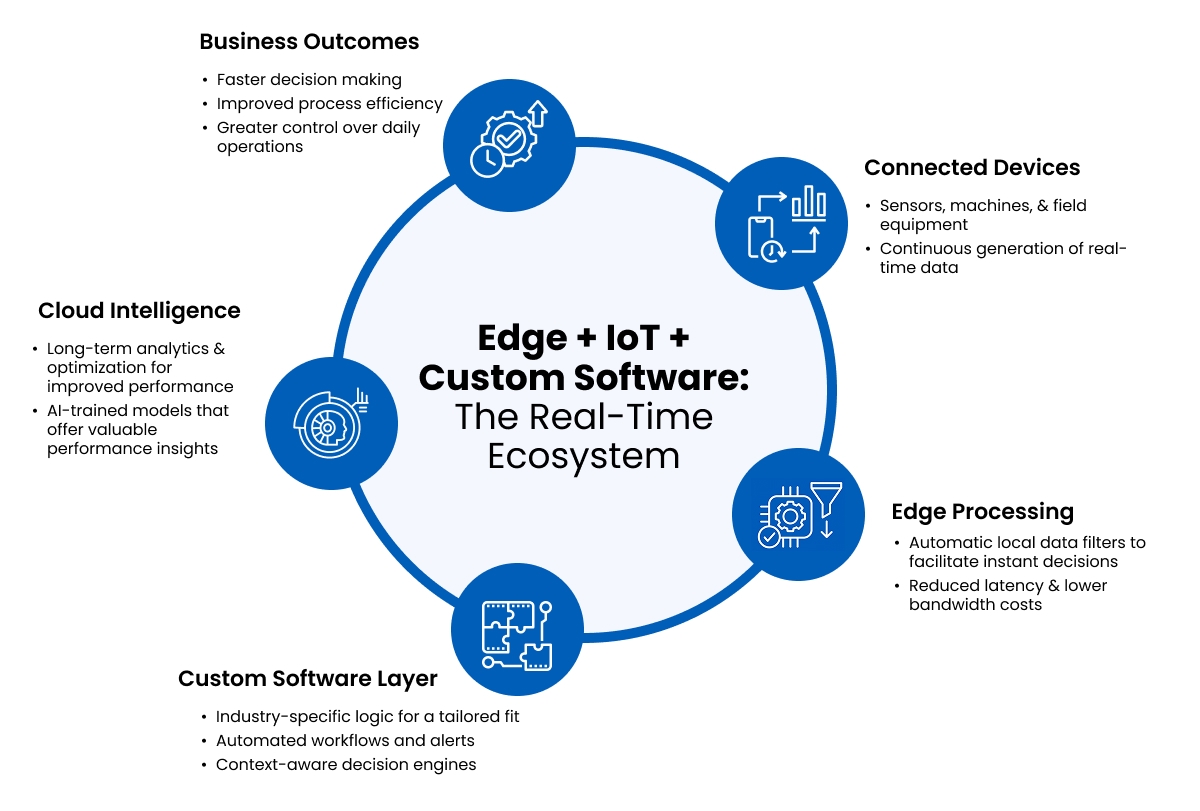
Heading into 2026, one thing is clear – businesses want tools that offer greater operational visibility and help them make snappy decisions. That means custom software is inching closer to where data is created. With edge computing and IoT ushering in a new generation of applications, you can expect faster responses than ever before.
Connected devices and real-time decision systems
Switching to edge-enabled custom software processes in 2026 is great as it will give you local access to all the data stored on the devices, sensors, and onsite systems your company uses. That means no latency along with improved readability so you can make sound decisions in real-time.
For Canadian manufacturers, logistics service providers, and utility managers, this is a major boon. Local data access translates to immediate response to equipment conditions, production changes, and safety events without the need to access a centralized system.
Impact on manufacturing and field operations in Canada
For industries such as manufacturing, energy, and transportation in Canada, the implementation of edge-based systems can result in massive efficiency gains. Predictive maintenance is a brilliant example. Triggered automatically, it can prevent your machines from breaking down. Moreover, automated quality checks ensure you don’t have to manually track everything.
Is edge computing necessary if the cloud framework is strong enough?
When it comes to batch processing and analytics, the cloud is still pretty much essential. However, for real-time control, equipment health monitoring, safety, and uptime, edge computing is critical. It eliminates dependence on network availability, thus keeping operational risks to a minimum.
Trend 6 – Legacy Modernization & System Integration
Though innovation in the tech and software world is moving at the speed of light, organizations still continue to rely on legacy systems that just were not built to handle today’s digital demands. However, that might change in 2026 as more companies treat legacy system modernization as their top priority.
Why enterprises still struggle with outdated systems
If a legacy system lies at the core of your company, you already know why it is so tough to move away from it. You cannot replace this tool without causing massive disruption in your company’s day-to-day operations. However, workarounds, manual processes, and siloed data are hardly the solution. In fact, they increase operational risk and slow down decision-making.
Custom software as the bridge to modernization
You can eliminate every issue a legacy system brings by walking down the custom software path. However, you do not have to do a full rip-and-replace to get started. With modern custom software, modernization can be an incremental process – thanks to APIs, middleware, and event-driven architecture. It’s your key to preserving institutional knowledge and unlocking new capabilities at the same time.
Isn’t buying off-the-shelf software cheaper?
Sure. Initially, it is. The low upfront cost might be tempting at first, but the ongoing subscription and per-user fees means that the cost will add up with time. Furthermore, generic software will force your company to adapt to its processes, thereby increasing your technical debt and inefficiencies in the long run. Opt for custom-built solutions from the start and you get tailored workflows that actually improve your ROI over time.
How To Prepare Your Organization For Custom Software Trends – An Implementation Checklist
The next big challenge is implementing the custom software trends that are the most appropriate for your organization. We have prepared the following framework for you so you can translate innovation into execution with minimal disruption.
Step #1: Assess your current software portfolio and business goals
If you are still relying on legacy platforms and manual processes, it is time for a change. However, make sure your custom software initiative aligns with your core business objectives. The goal of the new system should be to deliver immediate strategic value.
Step #2: Prioritize technology investment based on business impact
Your business likely does not need the blind implementation of every trend. What it needs are aligned solutions. By ranking opportunities based on ROI, scalability, and alignment, you will get a clear idea of what works best – whether it is a low-code platform, an AI-embedded system or cloud-native architecture.
Step #3: Build cross-functional capability and governance
Every single element needs to be in sync for your next-gen custom software initiative to work – from IT and operations to compliance and leadership. Establishing governance standards early helps in the maintenance of transparency and hierarchy, thus reducing instances of friction during transition. It also reinforces accountability for security, ethics, and performance.
Step #4: Choose the right partner and long-term roadmap
Treat selecting the right custom software development solutions partner as importantly as selecting the right tech stack. The team you collaborate with should be well-versed with the latest technology and have enough experience in building sophisticated platforms like we do at Vestra Inet. Our team is also highly aware of industry-specific compliance and will build a phased roadmap for you to ensure timely progress and milestone achievements.
Step #5: Monitor metrics, iterate, and scale
Launch is not the finish line for implementation. Success lies in tracking key metrics, whether it is adoption rates, performance improvements or cost savings. Use these metrics to guide continuous refinements that further boost your company’s ROI.
Readiness Checklist:
- Map your software initiative to concrete and strategic overarching business goals
- Identify gaps where custom software can deliver the highest value
- Pick and choose the emerging tech that makes the most sense for your business
- Formulate detailed data governance and compliance frameworks
- Select your innovation partner wisely and train your internal team for the new system
Looking Ahead – What to Expect in 2027–2030
The year 2026 is just the beginning of the evolution of custom software. The period of 2027-2030 will be defined by the convergence of cutting edge technology. Think AI meets automation and edge computing meets cloud-native platforms – and they all exist in a unified, intelligent system that can do it all.
Adaptive platforms that are capable of self learning, optimizing, and responding in real-time will change the way you interact with your business. In fact, the shift will not just be technical, it will be cultural.
If you want your company to thrive and succeed in this dynamic landscape, establishing data governance and ethical frameworks is critical. So is training your team so you can lead your company with confidence into the future that lies beyond the year 2030.
Conclusion
Next-generation custom software is the strategic edge your company needs to chalk out a scalable future for itself. The only way you can get there is by partnering with a team that is capable of building intelligent systems. Vestra Inet’s custom solutions for Ontario businesses integrate with legacy systems while offering advanced and highly scalable features. Contact us to get decade-defining solutions that offer sustained value.
FAQs
What are the top custom software trends for 2026?
The year 2026 will be all about low-code platforms, AI-driven automation, cloud-native architecture, legacy system modernization, and edge computing as far as the evolution of custom software is concerned.
How relevant is custom software in the AI era?
Custom software gives AI the anchor it needs to work for your business. It ensures that AI aligns perfectly with your company’s data, workflows, and compliance requirements so you can harness its true powers.
What industries benefit the most from next generation custom software?
Although every industry benefits in one way or the other, sectors such as manufacturing, healthcare, logistics, finance, energy, and B2B services stand to gain the most.
Are low-code platforms replacing traditional development?
No. The major purpose of low-code platforms is to speed up the deployment of specific modules. Enterprise systems are still built on custom architecture to ensure maximum security and integration.
What skills are needed to adopt next-gen software?
Data governance policies, cloud architecture expertise, change management capabilities, and team training are critical requirements for the adoption of next-gen custom software.
Author Bio

Andrey Wool
Helming the operations at Vestra Inet, Andrey has over 20 years of leadership experience in the ERP industry. Having successfully launched 550+ software projects across a diverse set of industries, Andrey continues to transform the way businesses function with pioneering custom software solutions. His in-depth knowledge of sectors such as manufacturing and distribution has helped him curate actionable solutions that eliminate bottlenecks and pave the way for sustainable growth.
