
Data-Driven Quote Systems: The Future Of B2B Sales & Forecasting
|
Data is everything. Period.
Running your business without data is like trying to hit a bullseye in the dark with a blindfold on. It is impossible. Especially when you take into account today’s ultra-competitive B2B landscape. If you leave data behind, you are likely going to be left behind as well.
Consider McKinsey’s report on B2B commercial analytics in this regard. It revealed that companies that manage to effectively harness the power of data analytics in marketing and sales had 1.5 times more likely to experience above-average growth rates compared with their competitors.
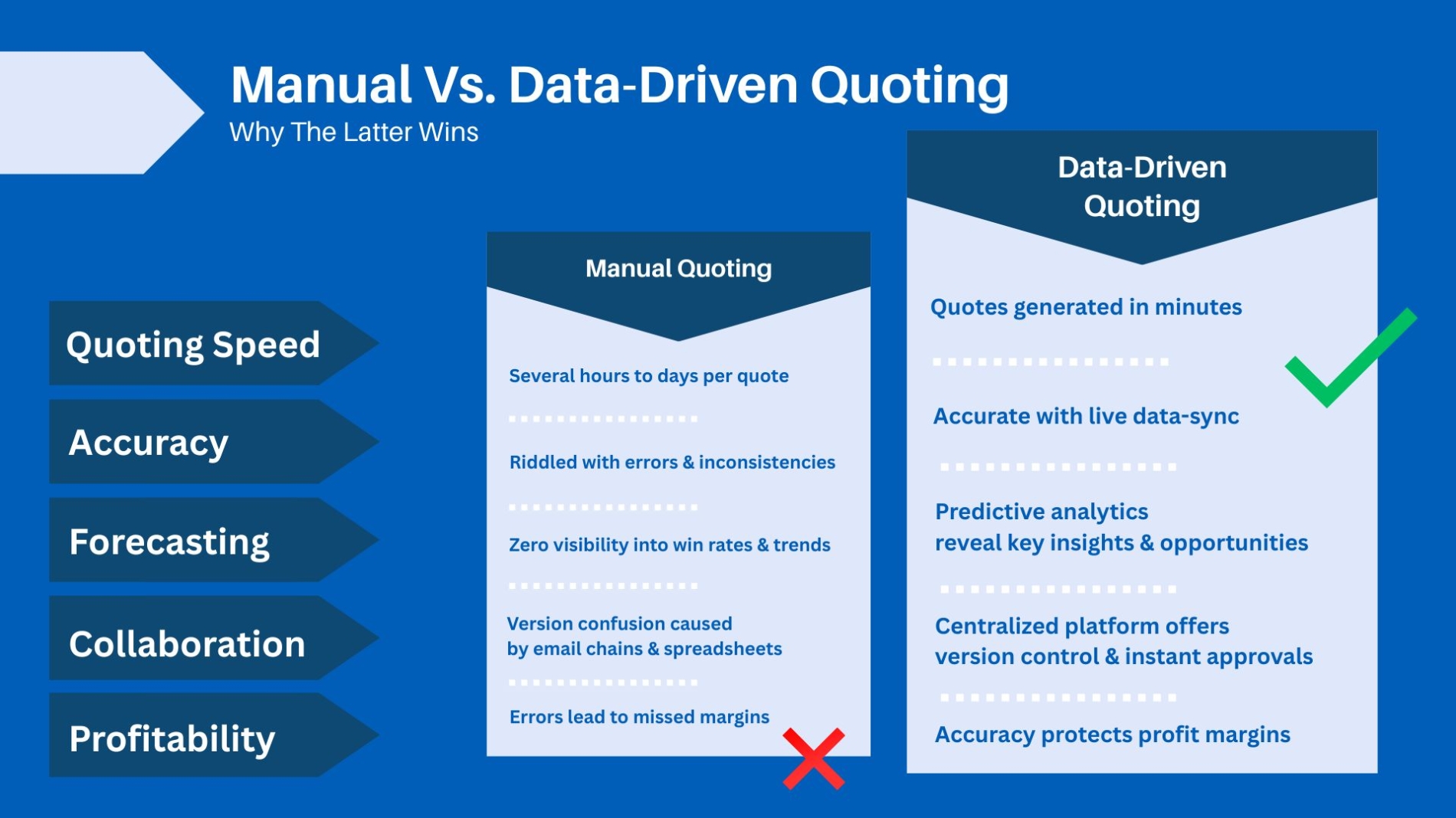
This is a classic case of when “numbers speak for themselves”. Therefore, if you want your numbers to speak for your business too, you have to take a long and hard look at its quoting process. Perhaps even get it ready for a complete overhaul because manual processes and generic software are not going to help you tap into the true potential of data-driven quoting.
Why? Because both of them are a hotbed for errors. While the fault in manual methods is obvious (human error), generic software causes data silos. Not only does this make quoting highly erratic and inconsistent, but it also leads to unpredictable forecasts, leaving decision-makers scrambling to make their best guess.
However, with data-driven quoting software calling the shots, all of these inconsistencies are instantly eliminated. Turning proposal creation into an intuitive and intelligent process, it connects with your ERP, CRM, and other platforms to offer precise and forecast-ready quotes.
Understanding Data-Driven Quoting Software
It’s time to put quotes based on instinct, guesswork, and spreadsheets to rest. While quotes crafted in this manner may have initially driven your business, they can no longer keep pace with your growth.
However, we know that replacing them with a new system can be challenging, especially if it’s unfamiliar to you and your team. Allow us to explain what data-driven quoting software is all about so you can get familiar with its nature and strengths.
What it is and how it works
Data-driven quoting software is not just a quote system – it is an ecosystem. Built with the intent to connect your company’s ERP, CRM, and analytics tools, it automatically pulls real-time data from each to ensure every proposal created is accurate and reflects actual costs and market shifts.
That means you can expect quotes to feature real-time values of materials, labor, and pricing trends, thus minimizing the need for revisions and manual look-ups. Consistent quoting is guaranteed.
Core Functionalities
Calling it a smart pricing software would not be an understatement. The major functions of a data-driven custom quote system have a transformative effect on the day-to-day of any B2B company they become a part of. Let’s explore:
- Automated quote generation: You can embed predefined logic unique to your business into the system to generate instant, error-free quotes that reflect the realities of your industry.
- Margin optimization: Part of what makes it smart is that this software constantly analyzes cost and sales data to recommend the most profitable pricing structures for your company.
- Predictive pricing suggestions: It automatically taps into historical data and AI-driven insights to suggest competitive pricing that yields the best results for your business.
Integration with CRM and ERP: Connected to the various tools in your software suite, this system always produces quotes that reflect real-world data, no matter how dynamic they are.
By leveraging the power of the ecosystem data-driven quoting software builds, your business can enjoy the perks of accuracy, transparency, and agility - which is exactly what it needs to multiply its sales. Plus, data-driven quoting means data-backed decisions.
Key Benefits Of Data-Driven Quoting In B2B Sales
Getting your numbers right is only half the battle won when it comes to B2B quoting. If you want to win the war, data-driven quotation making software should be a part of your arsenal.
Infusing quotes with the elements of precision, perfect timing, and sound strategy, it transforms quoting from a static administrative task to a dynamic revenue engine – and that is only the beginning of its benefits.
Enhanced quote accuracy
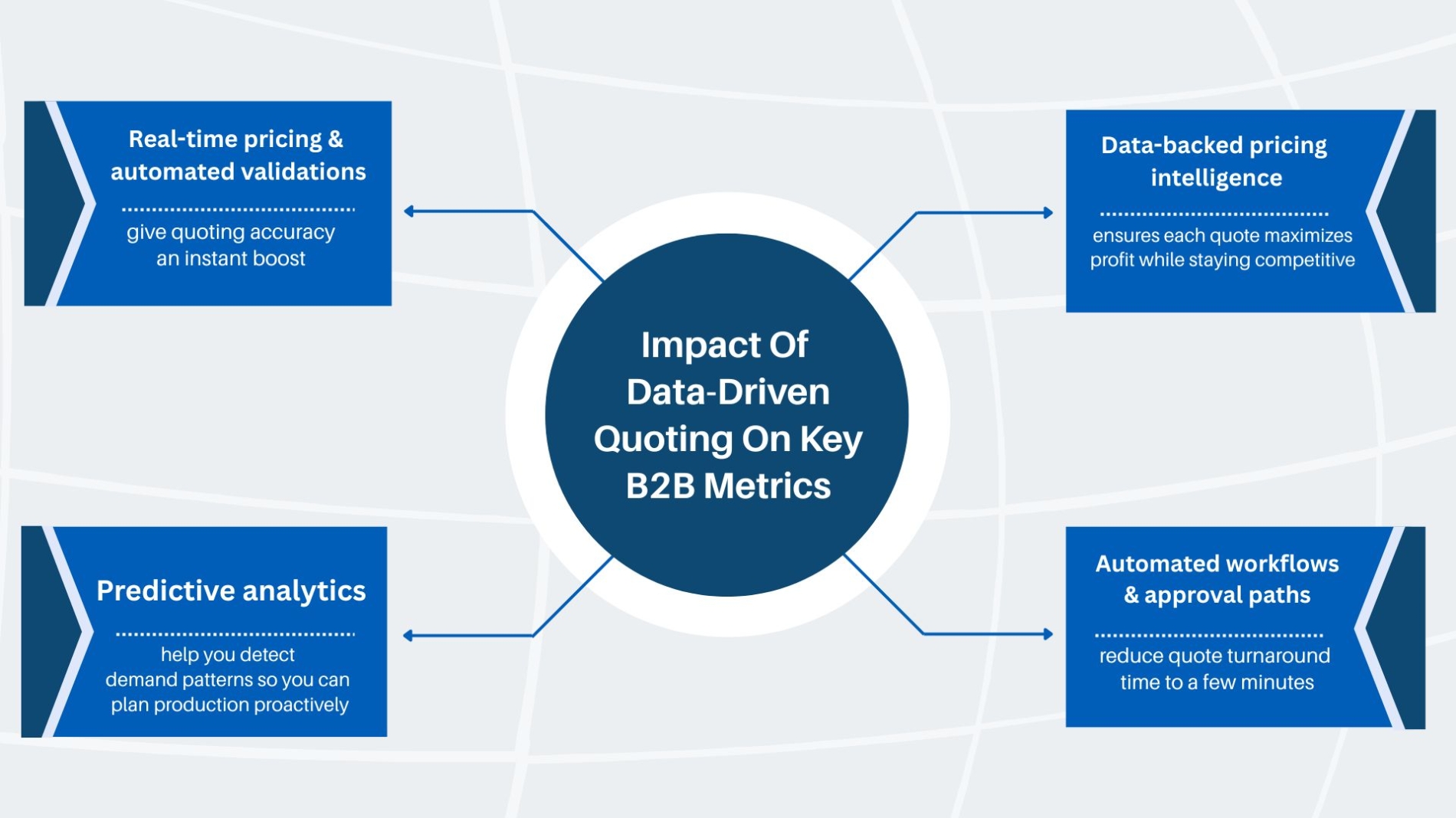
Fragmented inputs, when combined with rusty, old spreadsheets, are a recipe for errors. As you know, miscalculations can be very costly for your business. Data-driven systems end this problem once and for all by generating quotes with real-time pricing data. Their automated logic, combined with inventory visibility, wipes out instances of manual mistakes and prevents the generation of quotes with surprise markups. Custom CPQ software accuracy is truly unmatched.
Improved forecasting and demand prediction
Every quote your business generates is a goldmine of insights. The only way to unlock these insights and turn them into revenue is to use a modern quotation system. Capable of identifying key patterns in buying behavior, seasonal demands, and conversion rates, this tool can help you anticipate customer needs while optimizing stock levels and aligning production planning with the demands of the season. Think of it as a sales forecasting automation tool, not just a pricing powerhouse.
Reduced sales cycle time
Though you know your industry best, we think it’s safe to say that speedy quoting is bound to give you a competitive advantage in your sector. When sales cycle times reduce significantly, your conversion rates improve as you are no longer losing as many clients to competition as you used to. That is one of the major advantages of automating your entire quoting process.
Branded templates, predefined approval workflows, and real-time data inputs allow your teams to create complex quotes in minutes! Plus, your sales and operations teams finally work in sync, which means deals can be closed fast and orders fulfilled faster.
Greater profitability and margins
With AI powering the quoting system, identifying client segments, products, and configurations that yield the maximum profit becomes easier. You can consistently track your margins to ensure your business is heading in the right direction.
If that was not enough, this system is also capable of recommending data-backed pricing strategies that your sales team can use to strike the right balance between competitiveness and profitability when delivering proposals to potential clients. Over time, this turns your entire quoting process into a data-backed growth engine.
With data standing like a rock behind every strategic business decision you make, you are bound to witness rapid growth. But don’t worry about the system slowing you down. Evolution is in its DNA and it is designed to scale with your company.
Steps To Implement Data-Driven Quoting Software
Convinced that a smart pricing software is exactly what your business needs? We have to agree with you! It is one of the wisest decisions you will ever make. However, if you want this strategic initiative to be a resounding success, you need to plan its implementation right, and that means following a few unskippable steps which we have outlined for you below:
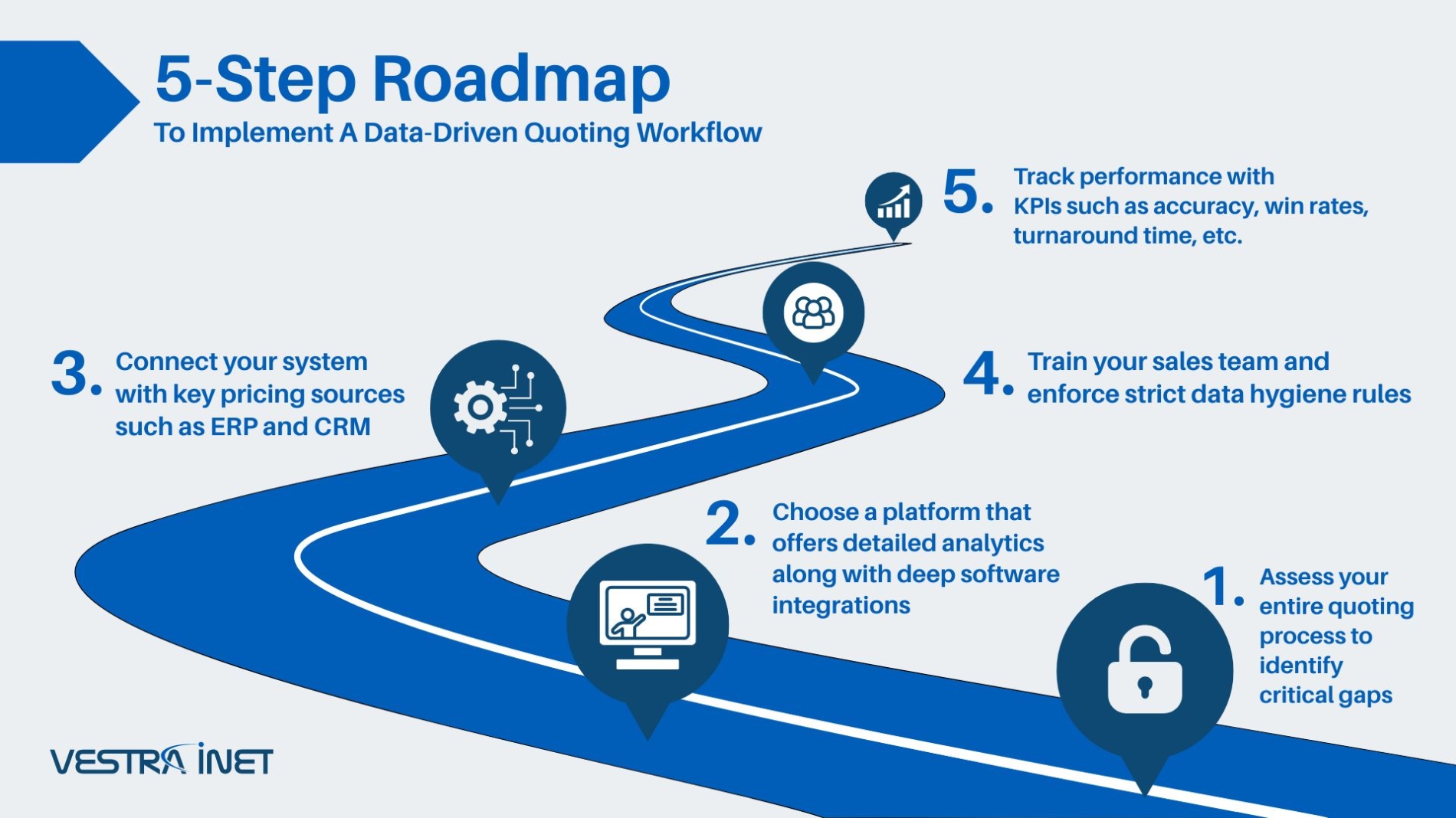
Step #1: Assess your current quoting process
Planning begins at home! Put your current quoting process under the microscope and figure out where the problem lies. What is slowing it down? Is it the increased dependence on emails and PDFs as data sources? Or perhaps the fact that your team has to re-enter data manually into your CRM and ERP is causing unnecessary duplication and confusion?
Whatever it may be, identifying all bottlenecks – major and mini ones – will help you determine exactly what your new custom quotation software needs to address. Make a list of manual touchpoints and pricing inconsistencies as well. In fact, documenting this entire audit is the only way to define the right data flows and automation priorities for your company.
Step #2: Choose the right quoting software
Just as options abound in all products and services, the market for quotation software is no different. Now you have a couple of key choices in this regard. You can either decide to go for one of the big-ticket branded software and pay a hefty premium, or you can pick a generic software and be struck with a rigid quoting process that is only marginally better than the methods you previously followed.
Fortunately, there is a secret third option and that involves partnering with a boutique vendor that can develop a custom quote system for you from scratch. Naturally, this system will be purpose-built to adapt to your business’s quoting protocols. It will also offer you other key benefits such as API integrations, predictive analytics, role-based access, and real-time dashboards, along with exceptional flexibility and scalability!
Step #3: Integrate with sales and CRM systems
Integration is what your smart pricing software needs to turn quoting into a powerful tool. With synchronized product catalogs, customer profiles, and quote history, your sales team can create the most accurate and up-to-date quotes instantly and consistently. Think of it as an engine that ensures consistency across every department in your company with its embedded pricing logic, customer-specific terms, and discount rules.
Step #4: Train teams and set data protocols
You might have heard it before, but technology truly is only as good as the people who use it. Therefore, if you want your new tool to display results quickly, you must provide in-depth, structured training to both your operations and sales teams.
Use the training period to establish and enforce strict data hygiene rules to maintain data accuracy. Some best practices include standard naming conventions, approval hierarchies, and centralized version control. Encourage your team to provide consistent feedback so you can continuously fine-tune the performance of your software.
Step #5: Measure performance post-implementation
Using clear performance metrics is the only way to understand the impact your brand-new quote system has had post-rollout. Some of the critical metrics you must focus on include quote turnaround time, forecasting accuracy, and win rates and margins. Tracking each of them will show you how you can optimize your tool’s predictive models and refine its pricing strategies.
Successful implementation is not a one-and-done process. It is an iterative exercise that centers around building a connected ecosystem where people and numbers work together to power smarter decisions.
Future Trends: AI & Predictive Analytics In Quoting Systems
Did you know that according to McKinsey survey of 1,000 sales organizations across the globe, 53% of them considered themselves “high-performing” only because they made effective use of data analytics?
Data truly is the present and the future.
As the world of B2B pricing becomes more fluid than it used to be, rule-based configurations have become a thing of the past. Modern quoting now demands true intelligence. That is where its future is headed – and it is all set to take quoting from automation to continuous optimization.
With AI quoting systems taking centerstage, machine-learning-based pricing signals are poised to be the new norm. Smart in every sense, they will automatically adjust different quoting parameters based on customer behaviors, conversion patterns, historical margins, and possibly even competitor influence.
In fact, AI models will get smart enough to identify and understand what actually makes for a winsome quote, whether it’s in terms of pricing or other variables. Predictive analytics in B2B quoting will also take a significant leap, helping your sales team create the most compelling quotes with probability-weighted revenue outlooks.
That’s not all. Another emerging trend is real-time competitive benchmarking, which will allow quoting systems to model market-acceptable price ranges way before a quote is sent out. This will help in reducing instances of over-discounting.
All in all, in the future, quote systems will not be mere generators but active advisors that help you reshape your entire sales strategy.
Conclusion
With data-driven quoting systems, guesswork is completely out of the picture. Now B2B pricing is all about predictable, profitable decision-making. Every quote is a reflection of real-time data, historical win patterns, and margin signals, thus creating a ripple effect of accuracy and efficiency. With your sales team quoting faster and your operations team planning better, nothing can slow you down.
If you are ready to turn your quoting process into a smart, revenue-driving engine, we are here to help you. As a leading provider of custom quotation systems in Ontario, Vestra Inet is adept at building solutions that effortlessly sync with your sales workflow and empower your teams with real-time insights. Contact us to get solutions that give you the competitive advantage you seek.
FAQs
What is data-driven quoting software?
It is a fully custom system that employs real-time data, analytics, and automation to generate fast and accurate quotes while forecasting potential revenue with each work order.
How does predictive analytics improve sales forecasting?
Predictive analytics tracks historical quote data to identify conversion rates and other factors, which in turn help in the accurate prediction of demand, success rate, and potential revenue.
Is data-driven quoting only for large B2B companies?
Absolutely not. Any company can reap the benefits of data-driven quoting software, irrespective of their size. Especially if they have complex pricing models or multiple quote variables.
How do I integrate quoting software with my CRM?
By choosing a vendor that provides custom software with API connections or native integrations like Vestra Inet does. Our software allows you to sync customer, product, and pricing data automatically.
What metrics should I track after implementation?
Once you have successfully implemented a custom quote system, you should keep tabs on its performance by tracking quote turnaround time, forecast accuracy, win rates, and margin improvements.
Author Bio

Andrey Wool
Helming the operations at Vestra Inet, Andrey has over 20 years of leadership experience in the ERP industry. Having successfully launched 550+ software projects across a diverse set of industries, Andrey continues to transform the way businesses function with pioneering custom software solutions. His in-depth knowledge of sectors such as manufacturing and distribution has helped him curate actionable solutions that eliminate bottlenecks and pave the way for sustainable growth.
