
Why Fabrication Shops Need Process-Driven Workflow Systems
Key Takeaways:
When workflows rely on spreadsheets, verbal coordination, and disconnected systems, fabrication shops begin to struggle. Conversely, a structured workflow-driven software improves:
- Production scheduling
- Material visibility
- Routing control
- Shopfloor coordination
Dedicated fabrication software allows scalable operation, letting companies grow without operational hurdles getting in the way.
Did you know the market size of structural metal product manufacturing Canada stood at a whopping $15.5 billion in the year?
That is the market share of just a single domain in fabrication. The size of the industry, at large, goes into multiples of billions!
Despite its rapid growth, fabrication is one sector that is to achieve the kind of operational efficiency it needs to achieve its maximum potential. Individual fabrication businesses within the country still rely on rudimentary methods such as spreadsheets, whiteboards, and verbal communication to conduct critical tasks like estimation, engineering, and production scheduling.
The result is a significant drop in efficiency. Disconnected processes have been famously known to contribute to operational blind spots, delays, and inconsistent reporting. They also limit scalability and make it difficult for businesses to maintain visibility across jobs, machines, labor, and materials.
So why are they still used and what can they be replaced by to unlock growth and efficiency? That is what we, Vestra Inet – developers of custom software in Ontario with 20 years of experience – will attempt to answer in today’s blog. Let’s get started.
Understanding Workflow Complexity In Fabrication Shops
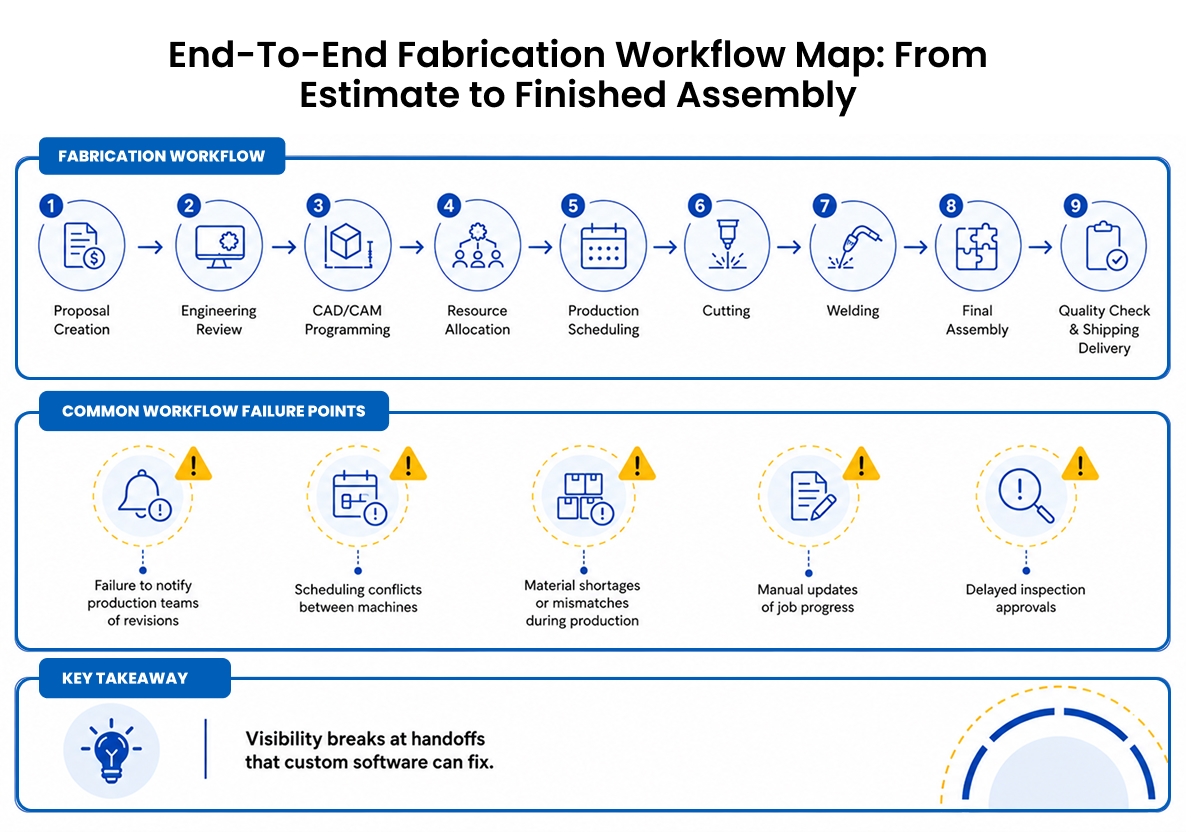
The processes of a fabrication shop might look linear from the outside but variables such as material availability, engineering changes etc. can introduce twists and turns that need to be effectively handled to prevent delays. Here are the major challenges fabrication shops face in this regard.
- Estimation to production handoffs
Fabrication workflows do not start at the shopfloor. They begin the very moment an order is received. The sales team uses drawings, labor requirements, and material costs to generate quotes. However, critical production details are often lost in translation as jobs hit the shopfloor.
Due to reliance on manual methods, there is a good chance that critical information such as engineering clarifications, revised customer requirements or updated specifications do not make it to the production team. Such handoff gaps can lead to inaccurate production and scheduling, thus emphasizing the importance of having a proper metal fabrication production management system.
- CAD/CAM integration and information flow gaps
CAD and CAM systems are the backbone of fabrication shops. These platforms are used for a wide variety of purposes including generating cut paths, inputting machine instructions, and managing production data.
Despite the critical role they play, they still operate in an isolated fashion, disconnected from scheduling or production tools. That means integrated fabrication shop workflow automation is crucial to ensure revisions, machine programming data, and routing updates sync with operational workflows to maintain a cohesive and consistent production environment.
- Material handling and routing availability
As we mentioned before, fixed sequences are not the norm in fabrication shops. Jobs tend to be complex and factors such as machine capacity, material availability, custom fabrication orders, and rush jobs can dynamically shift priorities throughout the day. Variable routing paths have the same effect. Only effective fabrication scheduling software workflow systems can handle this variability.
Where Fabrication Shop Workflows Typically Break Down
Efficiency breakdowns do not occur at a single point. Multiple errors take place simultaneously, revealing cracks in the processes fabrication shops follow. Cracks that can only be fixed with custom software.
- Scheduling conflicts
Scheduling can hit a wall as a fabrication shop scales its operations. Machine availability, labor constraints, and material shortages can disrupt production schedules, leaving businesses scrambling to complete pending orders on time.
However, with a centralized shopfloor workflow system, supervisors do not have to manually override schedules to ensure production goes as planned. Manual overriding might seem like an instant fix but it often gives rise to visibility issues, thereby affecting the fabrication of accurate components.
- Production updates that never reach planning
Delayed production reporting can throw an entire order off its course – especially as operators direct their energies to complete jobs anyhow rather than update the system in real time. That’s how planning teams end up with outdated information to work with, turning procurement and scheduling decisions into an unstructured nightmare. This disconnect leads to inconsistent production reporting.
- Inventory and material tracking inconsistencies
Another major failure point in fabrication workflows is material visibility. Losing track of partially processed materials is a common affair. In fact, remaining inventory and work-in-progress components often move through jobs without being tracked. Manual tracking makes matters worse, giving rise to inconsistencies that significantly increase the risk of production delays.
Checklist: Signs Fabrication Shopfloor Workflow Systems Are Breaking
Here is a quick wrap-up of process breakdown points on a fabrication shopfloor:
- Manual scheduling
- Untracked order changes
- Shopfloor confirmation delays
- Misaligned engineered and fabrication teams
Core Components Of Process-Driven Workflow Software For Fabrication
Process-driven workflow software is what fabrication shops need to flip the script in their favor. These tailored systems weed out inefficiencies at the grassroot level, leaving companies with streamlined processes that support sustained growth.
- Work-order orchestration and routing control
The most effective workflow software for fabrication shops is structured around orchestrating work-orders in the most effective manner. It ensures that every fabrication job sticks its own unique routing sequences instead of being forced to follow a template.
The entire journey – from cutting to welding and finishing – is accurately mapped out and regularly updated to ensure complete visibility into production progress, dependencies, and bottlenecks. With its tailored routing logic, operators can track where a job is in its journey at any time.
- Scheduling synchronization with machine capacity
Dedicated operations management systems understand that fabrication scheduling is dynamic and subject to last-minute changes due to factors such as machine maintenance, rush orders, set-up requirements or labor availability.
With each of these factors accounted for, dedicated tools are able to automatically align production timelines with job priorities and machine capacity. This is the fastest way to improve throughput and reduce production conflicts.
- Real-time production status tracking
For fabrication shops, constant visibility into shopfloor activities is paramount. Custom software enables real-time visibility into the progress of every order, capturing updates as and when they happen so supervisors can detect and respond to any bottlenecks that may arise. This prevents delays and improves proactive decision-making.
- Integrated and material WIP visibility
Syncing material availability with work-in-progress inventory and production activity is critical. Metal fabrication production management systems automatically track raw materials, WIP jobs, and finished assemblies to prevent material shortages from disrupting the workflow. They also help in minimizing lost inventory and improving coordination across departments – specifically production, purchasing, and shipping teams.
Steps to Digitize and Structure Fabrication Shop Workflows
Work on a fabrication shopfloor can seem very chaotic and difficult to digitize. However, taking a step-by-step approach will help fabricators with complex workflows streamline their processes and get the kind of operations software that supports its uniqueness without breaking down.
Step 1: Map existing fabrication processes and bottlenecks
A thorough understanding of how production currently operators will help leadership identify critical bottlenecks that slow the entire process down. Documenting routing paths, production dependencies, machine constraints, and approval stages will help them discover what critical workflows rely on so the entire system can be improved from the ground-up.
Step 2: Define workflow ownership and approval rules
Clear ownership at every stage of the workflow is the hallmark of efficiency. For that to happen though, sales, engineering, production and quality teams should have access to the same data all times. That said, accountability ensures each process stage moves as planned without approval handoffs halting the process.
Step 3: Align scheduling logic with machine and labor constraints
Real operational conditions should factor into production timelines on the shopfloor. Fabrication scheduling software workflow systems must align schedules with variables that can influence it such as machine availability, labor requirements, and material readiness. This ensures planned schedules are realistic and easy to follow through once the job hits the shopfloor.
Step 4: Integrate CAD/CAM outputs into workflow triggers
CAD/CAM systems are critical for workflow productions. That is why the data they carry should automatically trigger downstream production without manual interference. Integrated digital workflow for metal fabrication systems instantly connect engineering output production, routing, and scheduling to prevent bottlenecks.
Step 5: Build exception handling for custom or rush jobs
Unexpected changes are expected in fabrication environments. Ergo, their broader workflow should accommodate rush jobs, engineering revisions, or material shortages. This leads to the creation of software that is capable of dynamically adapting to evolving requirements without causing any disruptions.
Checklist: Workflow Digitization Steps For Fabrication Shops
Here is a quick checklist to help fabricators develop their workflows to support digitization initiatives:
- Map and document current workflows
- Identify manual data entry points
- Define event-based production updates
- Validate shopfloor reporting patterns
- Establish and embed workflow exceptions
Automating Fabrication Workflows Without Losing Control
The fear that automating their process will lead to loss of control is one that many fabricators share. The good news is automation need not cause losing control. Here is how:
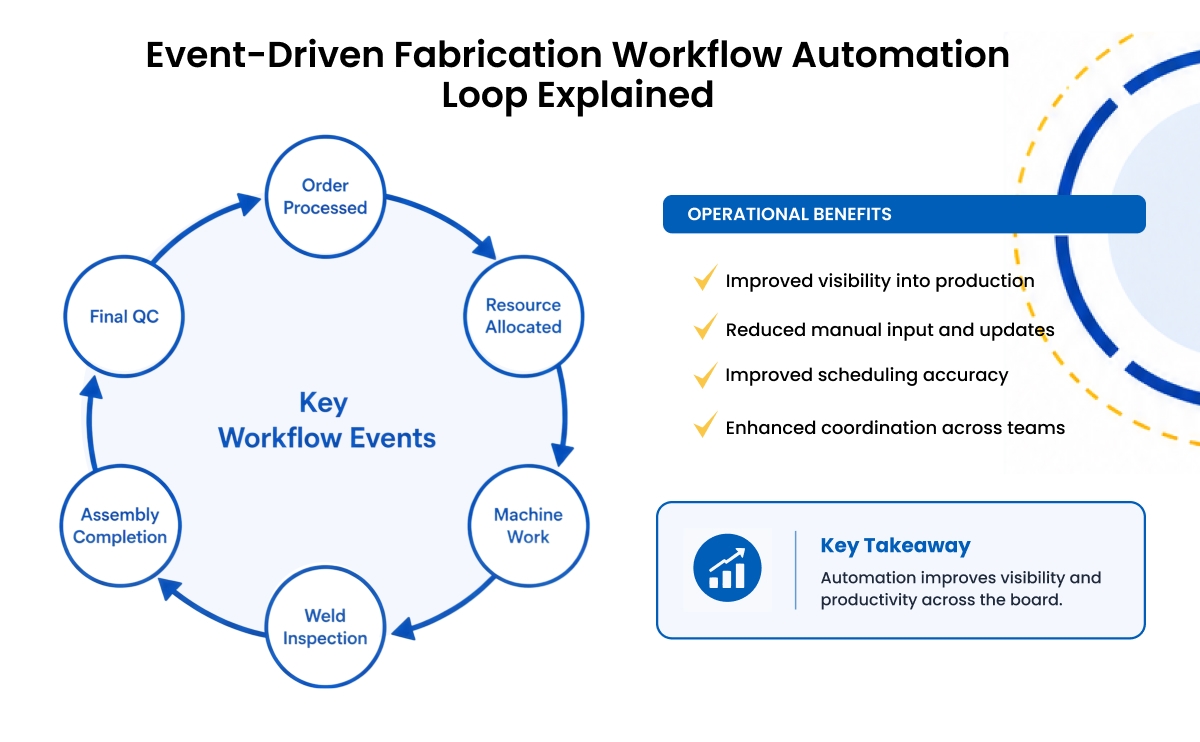
- Event-driven job status updates
Manual updates increase after-hours work and cost to the company. However, fabrication software replaces manual reporting with event-driven updates that are automatically triggered based on real production activity. Fabricators still get full control over which events trigger these updates.
- Digital dashboards for shop supervisors
For supervisors, immediate visibility into production performance, bottlenecks, and labor allocation is a must to efficiently manage work orders, schedules, and resources. Custom software with their detailed dashboards provide live operational data, allowing operators to make critical decisions faster.
- Reducing paperwork and manual coordination
Manual reporting isn’t control. It is a breeding ground for inconsistencies and inaccuracies that can have a cascading effect over the future processes and orders of a fabrication company. By eliminating printed schedules and paper trails, operations software centralizes key production data into a single platform. This reduces administrative overload while improving accuracy and preventing communication delays.
Scaling Workflow Systems For Growing Fabrication Operations
Just like fabrication quotation automation helps fabricators manage growing work orders, custom operations software also supports scalability of the company’s production systems and processes.
- Managing multi-project and custom job environments
Growth brings increased complexity for fabrication shops. The best way to manage more customers, more custom projects, and overlapping schedules is to use scalable software that enables the simultaneous coordination of multiple projects while maintaining visibility into resources and schedules.
- Preventing workflow drift during expansion
Departments are likely to create their own unofficial processes as companies experience rapid growth spurts. Over time, these disconnected practices create workflow drift, leading to inconsistent and difficult-to-track operations. Scalable workflow software for fabrication shops implements standardized yet flexible workflows to control expansion-induced drifts.
- Coordinating multiple fabrication cells
The addition of specialized fabrication cells or departments is a common part of expansion for fabrication shops. Custom manufacturing software helps bridge communication gaps between cells, thus reducing production delays and scheduling conflicts. Such structured systems also improve the sync between different fabrication processes such as cutting, welding, finishing etc.
Conclusion: Why Process-Driven Workflow Systems Define Fabrication Success
With process-driven workflow fabrication systems, businesses do not have to fear or change their dynamic environments and shifting priorities. Their tailored structure helps them to adapt to changing requirements while aligning engineering, scheduling, inventory, and shopfloor execution. This results in improved operational coordination and visibility.
Dedicated fabrication software are also scalable by design – especially because they centralize operations, eliminate disconnected systems, and do not require manual input. Moreover, they help businesses maintain the kind of efficiency needed to support long-term growth without falling prey to operational risks.
Looking for custom manufacturing or operations management software? Vestra Inet is a Toronto based software development company with 20 years of experience in delivering tailored solutions perfect for Ontario’s manufacturing and fabrication industries. Contact us to speak to our workflow software specialist.
FAQs
What is workflow software for fabrication shops?
Workflow software for fabrication shops is a tool that helps fabrication companies manage scheduling, routing, production tracking, and operational workflows.
How does workflow automation improve production?
Automating fabrication workflows improves scheduling accuracy while reducing manual coordination. It also brings greater visibility into real-time production.
Why do fabrication shop workflows fail as orders increase?
Fabrication workflows are complex to begin. Growing orders increase this complexity, especially in scheduling, engineering revisions, and coordination across departments. Manual systems cannot manage these efficiently, causing existing workflows to fail.
Can workflow systems integrate with CAD/CAM tools?
Yes, modern systems, such as the ones we design at Vestra Inet, can seamlessly integrate with CAD/CAM software to automate production processes and routing paths.
What should small fabrication shops consider before implementing workflow software?
Every fabrication shop that wants to implement workflow software should begin by mapping their workflows, identifying bottlenecks, and clearly defining their operational processes.
Author Bio

Andrey Wool
Helming the operations at Vestra Inet, Andrey has over 20 years of leadership experience in the ERP industry. Having successfully launched 550+ software projects across a diverse set of industries, Andrey continues to transform the way businesses function with pioneering custom software solutions. His in-depth knowledge of sectors such as manufacturing and distribution has helped him curate actionable solutions that eliminate bottlenecks and pave the way for sustainable growth.
