
Custom Manufacturing Workflow Software: When & Why It Matters
|
The manufacturing sector of Canada witnessed sales worth $68.7 billion in January 2026 alone. That single statistic alone is enough to paint an accurate picture of just how fast-moving this industry is in the country.
In fact, almost every manufacturing business in the country is in a constant state of evolution. As production volumes increase, workflows become more complex. They seldom ever assume the linear sequence of “plan, produce, deliver”. Instead, processes pause, loop, and adapt constantly, introducing complexity that rigid software is not capable of handling without breaking down.
Scaling operations also exposes gaps in your existing management systems. As inconsistencies compound, departments, timelines, and teams become harder to manage. Signs such as miscommunication, inconsistencies, and delays clearly indicate that your current manufacturing operations workflow is no longer supported by your current system.
That’s where custom software steps in as an eleventh-hour Samaritan. It bridges data and visibility gaps, optimizes workflow, and restores consistency across the board. Let us at Vestra Inet, Ontario’s leading software development company, illustrate how production workflow management with the help of custom software is the way forward.
What Manufacturing Workflows Really Look Like on the Ground
On the face of it, manufacturing workflows can seem as simple as 1-2-3. After all, you simply have to plan production based on orders received, right?
Wrong. It’s never this clean. Handoffs are more complex than they appear, and production cycles depend on a myriad of factors – from the engineer’s approval to the availability of materials, machines, and more.
This level of complexity makes having custom ERP vital for small manufacturers in particular, but we are getting ahead of ourselves. Let’s take a look at the ground reality of a manufacturing workflow:
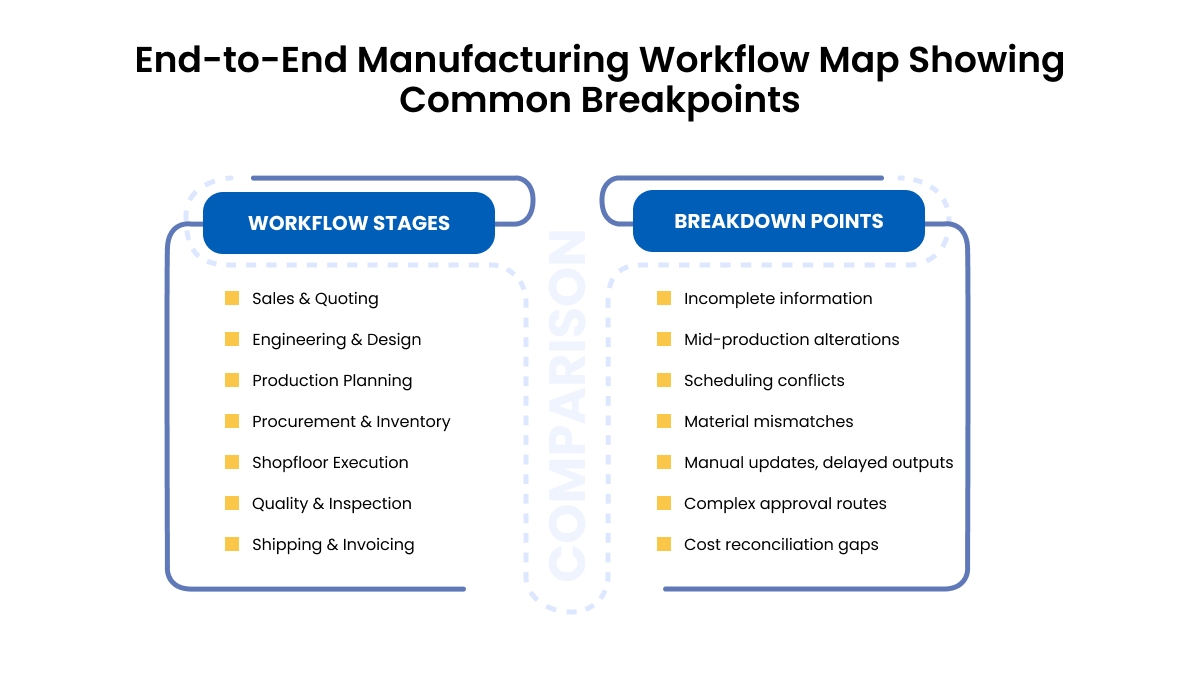
Quote-to-production handoffs
The first step in the production process does not require the use of machinery – it requires the use of software for the generation of accurate quotes. However, at this stage, most sales teams have no choice but to create quotes based on partial information without engineering validation. Once the full picture is obtained, changing details can invariably cause friction in manufacturing operation workflows.
Engineering change loops
Engineering teams can't approve designs up front. Alterations based on feasibility, materials available, and client input can create loops that can be difficult to manage without custom manufacturing software.
Production planning and rescheduling
Production plans can go through changes depending on a myriad of factors such as machine availability, job priority, and material constraints. To get back on track, companies need a production workflow management system that supports the dynamic nature of their production schedules.
Inventory dependencies across departments
A manufacturing company’s inventory does not exist in isolation. It is closely tied to the major 3Ps of manufacturing – production, procurement, and planning. Any sort of delays in restocking or inaccurate stock levels can disrupt the entire production workflow.
Signs Manufacturing Has Outgrown Generic Systems
While growth is a good sign for your company, it is a bad sign for the generic software you use to manage your business’s production workflows. As workflow increases, cookie-cutter tools start to crumble, clearly indicating it is time for a change:
Manual workarounds between systems
To begin with, gaps should not exist in a company’s software suite. If they do, spreadsheets and emails are hardly the best solution to tackle them. A complete software overhaul is needed to address limitations and support real workflows.
Spreadsheet-driven production decisions
When spreadsheets become the most reliable source of truth despite the existence of ERP and MES tools, it is a problem. Relying on spreadsheet data for decision-making can introduce new risks.
Delays caused by cross-team misalignment
Lack of seamless information flow between departments leads to avoidable delays while hinting at the use of broken manufacturing process software.
Data inconsistencies across operations
Chaos caused by conflicting reports and inaccurate data can make team members lose trust in the system and replace it with manual processes instead.
Checklist: Red Flags That Indicate Workflow Failure
Other glaring signs to watch out for include:
- Manual re-entry of data
- Mismanaged production schedules
- Lack of real-time visibility into company processes
- Over-reliance on key team members for information
- Output inconsistency
Why Off-the-Shelf Software Falls Short
Off-the-shelf software is a great starter pack for most manufacturing companies. However, its shortcomings can make it a poor choice in the long run, thus necessitating a switch to manufacturing software solutions.
Rigid process assumptions
Standard assumptions are rigidly baked into the DNA of generic software, thus limiting the effectiveness of manufacturing workflow automation in dynamic production environments.
Limited adaptability to custom manufacturing
Accommodating variability is not the strong suit of off-the-shelf software. This makes them a poor choice for custom jobs, changing BOMs, and dynamic routing.
Fragmented modules instead of unified workflows
Standard ERP and MES systems are built to segregate different functions into different modules. While this might seem like an efficiency-boosting hack, a lack of integration between different modules can force teams to manually coordinate, giving rise to data inconsistencies at every stage of the production process.
Configuration limits vs real operational needs
Although generic tools are configurable, they still come with a set of unflinchingly rigid pre-defined boundaries that cannot be changed. Real manufacturing workflows are more complex and dynamic than what these solutions can incorporate.
When Custom Manufacturing Workflow Software Becomes Necessary
Whether you adopt a lean manufacturing approach or deal with mass production, either way, a custom manufacturing workflow can benefit your business. Especially in certain situations:
High variability in products or jobs
From custom orders to ETO processes, manufacturing environments exemplify dynamism. In such an atmosphere, software that can constantly adapt itself to changing requirements is the only kind that works. Others just turn into limiting bottlenecks.
Complex approvals and decision paths
Manually managing complex approval chains is a recipe for unwarranted delays. Custom software routes approvals based on a company’s individual processes, whether that involves multiple stakeholders or several conditions.
Tight coordination between engineering, production, and inventory
Manufacturing workflows require constant communication to go smoothly. Unified custom manufacturing systems eliminate data silos, improve cross-departmental coordination, and ensure top-down process alignment.
Need for system behavior to mirror real processes
Software systems must reflect the realities of a business rather than following generic assumptions that apply to no company in particular. The real value of a software lies in how well it can adapt to your organization’s manufacturing process and support its growth and scalability.
What Custom Workflow Software Enables in Manufacturing
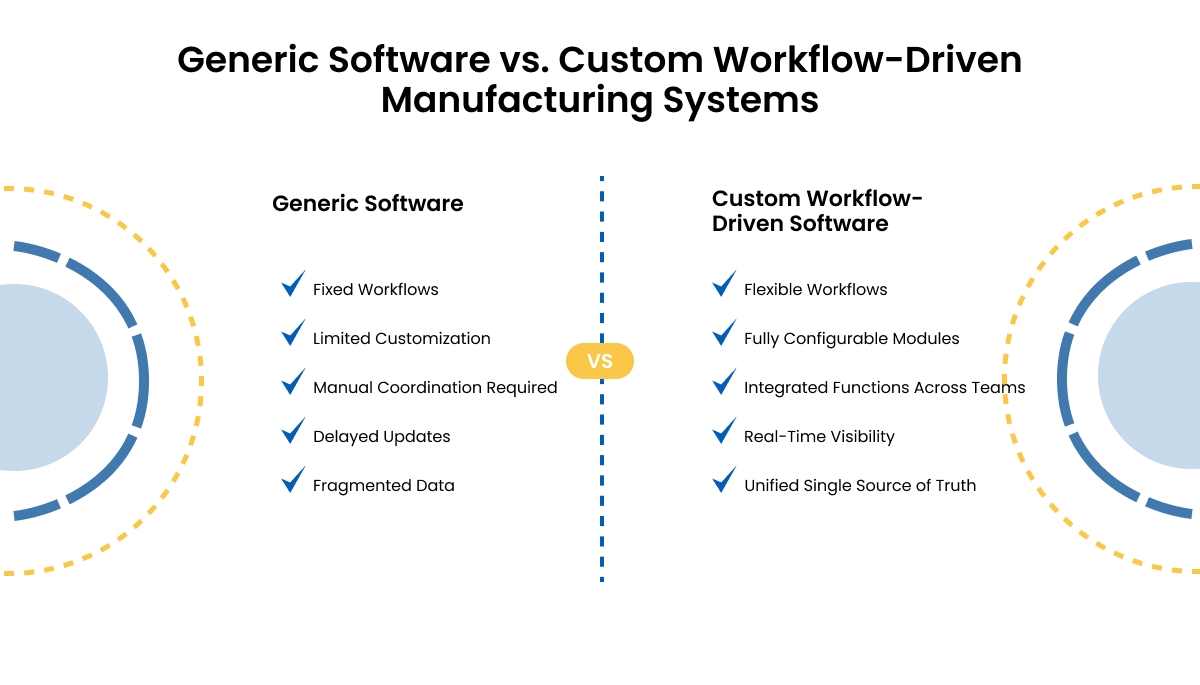
Custom workflow-driven software brings about a new level of efficiency that most manufacturers desire but are unable to achieve with generic tools. Implementing tailored solutions introduces:
Process-first system design
Instead of being forced to use workflows that do not match operational realities, custom manufacturing workflow software reflects and aligns with real company processes.
Real-time operational visibility
With accurate and up-to-date data available at all times, leadership can take more fruitful and strategic decisions that support growth. Moreover, integrated production workflow management improves operational visibility across the board.
Fewer handoffs and manual interventions
Automated processes increase efficiency while reducing dependency on manual coordination. The result is a silo-free workflow where information and processes flow from one stage to the next without encountering bottlenecks along the way.
Scalable workflows that evolve with operations
Workflows evolve at the same rate as manufacturing operations do. While generic software cannot keep up, custom manufacturing systems adapt to increased workload and operational complexity without any disruptions.
Vestra Inet’s workflow-driven manufacturing systems have a proven track record of boosting operational efficiency, data accuracy, and inter-departmental coordination. Over 550 businesses in Ontario have reaped the benefits of our tailored solutions to date.
Mapping Manufacturing Workflows Before Building Software
Custom software works best if it is built on clear processes, functions, and workflows. However, many companies do not know where to begin. Keeping the following in mind can be a good starting point:
Identify true process owners
Make a list of each team member who plays a pivotal role in handling the different processes of your company. Recognizing key leaders results in effective production workflow management.
Document decision points and expectations
Having a concrete record of real-world production scenarios ensures the custom system’s modules align with real operational workflows, not assumptions.
Separate rules from assumptions
Another way to ensure your manufacturing workflow automation initiative pays off is to draw clear boundaries between fixed rules and flexible processes so that the software can apply relevant logic accordingly.
Design systems around reality, not theory
Mapping accurate workflows and using them as the foundation for your custom software project ensures minimum user resistance and maximum adoption, as team members can see and feel the positive changes it brings.
From Workflow Design to Working Manufacturing System
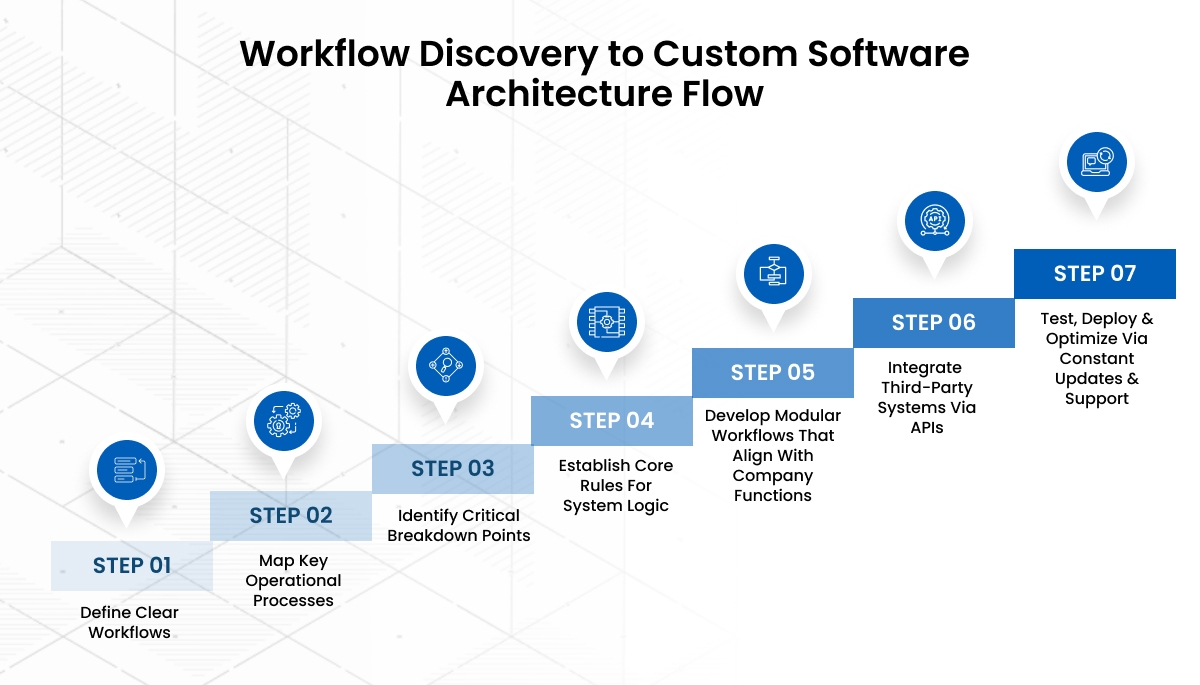
The journey from a workflow design to a working manufacturing system is riddled with critical milestones, which include:
Translating workflows into system logic
One of the first milestones is converting predefined workflows into rules, triggers, and behaviors that can be embedded into the system to ensure it performs expected functions.
Incremental rollout and validation
A major benefit of custom manufacturing software is that it can be rolled out in a phased manner to ease teams into adoption, minimize friction, and reduce disruption. It also gives teams enough time to provide real feedback, which can be used to make changes if necessary.
Operator adoption and feedback loop
Continuous feedback helps in refining the system while improving company-wide adoption. At this point, it makes sense to appoint a champion in each team who can guide their team members toward the correct use of custom software.
Continuous improvement without system rebuilds
Flexible software supports continuous optimization so it can evolve and scale as manufacturers achieve their growth goals.
At Vestra Inet, we collaborate with manufacturers to create a roadmap that allows for the effective development and implementation of workflow-driven software. Read how we helped one of our esteemed clients achieve the pinnacle of operational efficiency here.
Why Custom Workflow Software Is a Long-Term Advantage
With custom workflow software, manufacturers get a system that adapts to evolving workflows without introducing new limitations or bottlenecks. That means companies get a tool that actually supports long-term growth while reducing errors, risks, and operational inefficiencies. Reliable data enables better decision-making as well, making custom software one of the most worthwhile investments a business can make in this day and age.
Conclusion – When Software Should Follow Manufacturing Reality
The key to having the most effective manufacturing software is to lay its foundation in clear workflows. Custom systems should support operations, not constrain them – something that is only possible when the final software aligns with real workflows.
Need custom software for your manufacturing business? Vestra Inet has 20 years of experience as one of the most trusted custom software development companies in Ontario. Contact us to get systems that boost operational visibility and scalability without any pitfalls.
FAQs
What is custom manufacturing workflow software?
Custom manufacturing workflow software is a tool designed around a manufacturing company’s real workflows. This system enables flexible and error-free production cycles.
When should manufacturers consider custom workflows?
Manufacturers should switch to custom software when their existing tools cause errors and inefficiencies across the board. Systems that fail in handling operational complexity and variability should be swapped with tailored solutions that support growth and improve coordination among teams.
How is custom workflow software different from ERP or MES?
Custom software takes a workflow-oriented approach, which improves manufacturing automation, proposal creation, production scheduling, inventory tracking, engineering approvals, and quality assurance.
Does custom workflow software scale with manufacturing growth?
Yes, it is purpose-built to adapt to evolving processes and workflows, thus supporting a manufacturing company’s long-term growth.
How long does it take to build manufacturing workflow software?
Timelines vary and depend on the software’s scope and complexity. However, phased rollout can make the implementation process much faster and smoother.
Author Bio

Andrey Wool
Helming the operations at Vestra Inet, Andrey has over 20 years of leadership experience in the ERP industry. Having successfully launched 550+ software projects across a diverse set of industries, Andrey continues to transform the way businesses function with pioneering custom software solutions. His in-depth knowledge of sectors such as manufacturing and distribution has helped him curate actionable solutions that eliminate bottlenecks and pave the way for sustainable growth.
