
Designing a Workflow System for Discrete Manufacturing Operations

Key Takeaways:
To create a unified operational structure, manufacturers need to align production, inventory, and scheduling. A well-designed workflow system for discrete manufacturing is key for:
- Maintaining control
- Improving visibility
- Enabling scalable operation
Keep manufacturing operations running smoothly even as complexity increases with a properly structured workflow.
High variability is built into the DNA of discrete manufacturing operations. Each product has to be assembled using multiple components, which requires taking different routing paths to get to the finish line.
This approach is quite unlike continuous production systems, which tend to be more linear. However, in discrete manufacturing, job requirements can change the fly. Engineering teams may have new updates and priorities are likely to shift to cater to more urgent demands.
Such high variability creates a complex landscape. Effective discrete operations management demands close coordination between teams, systems, and data flows – especially as production scales as that only increases complexity.
That is why creating and implementing structured workflows is necessary. Fragmented systems do not offer the kind of cohesion discrete manufacturing operations require. In fact, they are the major cause behind inconsistent reporting, delayed updates, and poor visibility into real-time production status.
In today’s blog, Vestra Inet – developers of sophisticated custom manufacturing software in Ontario, will outline the importance of integrated manufacturing process orchestration and how it can support smooth, scalable growth and operational control in the long run.
What Makes Discrete Manufacturing Workflows Unique
Discrete manufacturing deals with the production of highly complex items – think smartphones, cars, furniture etc. Not only are each of these products distinct and countable, they are made up of multiple parts which can be disassembled. They rely on assembly lines and specific routing, and that makes their workflows inherently unique.
- Discrete vs process manufacturing workflow differences
There is a wide chasm of differences between process and discrete manufacturing workflows. While process manufacturing is job-based and linear, discrete manufacturing is its direct opposite. It does not follow a continuous and predictable flow that is driven by fixed formulas or tried-and-tested recipes.
Instead, it focuses primarily on the assembly of individual components. Each component comes with its own routing and production steps which can differ from those of other components within the same assembly. The end result is a variable process that demands flexible workflow automation for discrete manufacturing – ideally the kind that is quick to adapt to changing requirements and is not rigid.
- Bill of materials driven production complexity
Central to discrete manufacturing, Bill of Materials or BOMs dictate the components and the workflow required for each project. But even these BOMs are subject to change depending upon engineering updates, customer requirements or component substitutions Each of these changes create a ripple effect, impacting inventory allocation, scheduling, and shopfloor execution.
Managing this complexity requires manufacturing software solutions that can automate the unique workflows of discrete manufacturing companies while swiftly handling multi-level BOMs and dependencies.
Core Components Of A Workflow System For Discrete Manufacturing
To design a proper workflow system for discrete manufacturing, it is important to treat its variability as the foundation instead of a nice-to-have. Each of the features we have mentioned below should stem from this variability.
- Work order management and routing logic
The backbone of any workflow system for discrete manufacturing, work orders define exactly what needs to be produced and how. They also outline the sequence in which production should take place.
Meanwhile, routing logic ensures work order follows that predefined sequence, whether it's in terms of machine use or approval stages. Structured routing helps in the maintenance of consistency, thus reducing error rates which are in complex production flows.
- Inventory synchronization and material flow control
When inventory and production workflows are tightly wound together, true efficiency can be achieved. Constant communication between the two ensures materials are available when needed, thereby reducing delays caused by shortages or misallocation. Effective manufacturing process orchestration also enables tracking of material use in real-time while automating restocking alerts and aligning procurement and production schedules.
- Production scheduling and resource allocation
Scheduling in discrete manufacturing is not for the faint-hearted. Balancing multiple variables such as machine capacity, labor availability, and job priorities requires serious coordination across departments.
A strong production workflow management system can take manual load off from this process by dynamically adjusting schedules based on real-time conditions. This ensures the optimum utilization of process and keeps intact the kind of flexibility such manufacturing environments need.
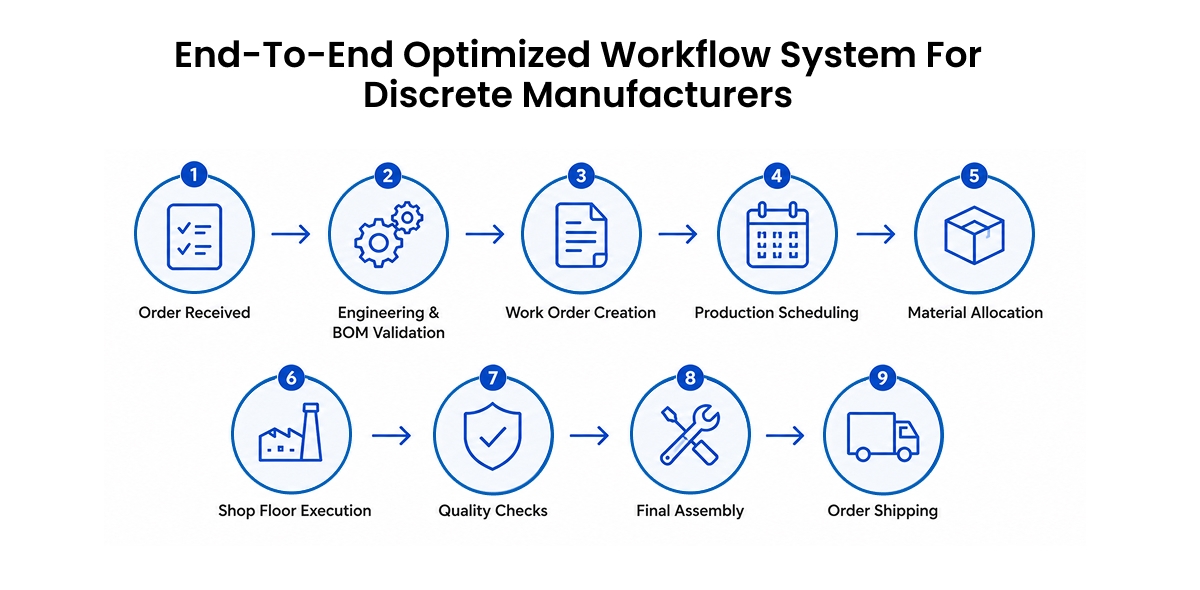
Where Discrete Manufacturing Workflows Typically Break
Considering the inherent complexity of discrete manufacturing processes, it is easy to imagine several breaking points. However, production typically suffers at certain junctures in the journey which include:
- Engineering to production handoff gaps
One of the first points of breakdown happens very early in the process, and that is when the changes made by the engineering team are not fully conveyed to the production team. Disconnected systems may not reflect updated BOMs or routing instructions in real time, leading to errors in builds and consequent reworks. This disconnect can disrupt discrete manufacturing operations management, thus negatively affecting the entire workflow.
- Shop floor reporting inconsistencies
System updates might get lost or ignored as operators prioritize production updates. In any case, the result is an incomplete data set that only paints half the picture and introduces inconsistencies into the production workflow management system. This, in turn, reduces faith in the data available, forcing teams to reconcile gaps manually.
- Inventory and WIP visibility disconnects
Unfortunately, in complex production environments, it is common for inventory and WIP or work-in-progress logs to lag behind actual production activity. Lack of real-time updates in this arena means manufacturers do not have real-time insight into material usage and job progress, which can create blind spots that consequently lead to ineffective decision-making.
Checklist: Indicators Of Workflow Failures To Watch Out For
Discrete manufacturers should always have the following workflow failure indicators on their radar:
- Unclear ownership at various stages of the production process
- Manual updates that happen outside of their designated systems
- Delayed production confirmations
- Routing expectations that haven’t be accurately captured in reports
Designing An Effective Workflow System For Discrete Operations
The first step to creating a workflow system for discrete manufacturing that actually works is to ensure it addresses the breakdown points we discussed in the previous section. That is possible if the following factors are accounted for:
- Mapping real production sequences before system design
Designing an effective system requires a deep understanding of how work actually flows within the organization. This involves determining the real sequence of a typical production, including any variations, dependencies or exceptions that may arise. Having a clearly mapped workflow eliminates guesswork, leading to the creation of a system based on operational realities.
- Aligning workflows with BOM structures and routing rules
To achieve operational excellence, it is critical for workflows to follow the exact structure as spelt out in BOMs along with the routing paths that define production steps. Aligning both ensures that every aspect of the manufacturing process, including materials, operations, and approvals are in sync. This can considerably reduce errors in production, leading to the manufacturing of products of consistent quality.
- Integrating quality control checkpoints into production flow
A complete workflow treats quality control as an essential part of its process rather than a separate function. In fact, integrating quality checkpoints into the system helps in the early detection of defects and other issues, thus reducing instances of rework while improving efficiency from top to bottom.
Checklist: Steps To Designing An Effective Discrete Manufacturing Workflow
- Examine and record existing stages of production
- Identity workflow bottlenecks or breakdown points
- Clearly define routing logic and approval rules
- Synchronize inventory management and production cycles
- Establish exceptions variations, and dependencies
Automating Production Workflows Without Losing Operational Control
Many manufacturers fear losing complete control over their internal production processes with the implementation of automation processes. However, it is to maintain operational control by using custom manufacturing software solutions that allow:
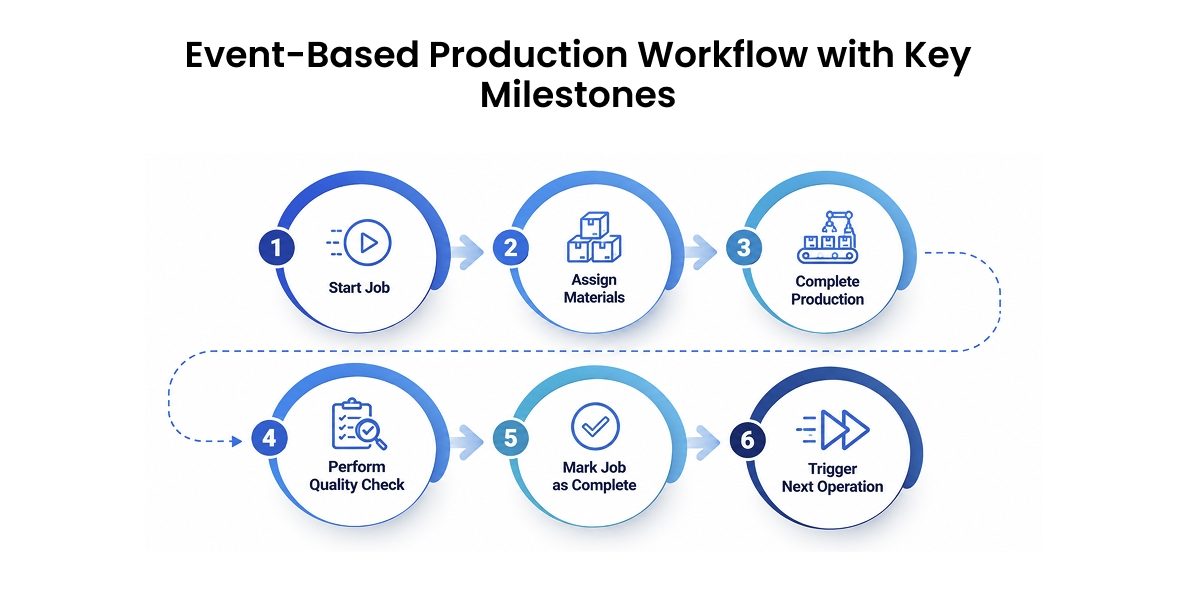
- Event-based production updates
Custom software allows manufacturers to implement event-driven workflow triggers that reflect real production activities rather than relying on inconsistent or error-prone manual input. This approach actually works in the favor of manufacturers as it improves accuracy and makes it easier to stick to production timelines – both of which are critical for the smooth functioning of a discrete manufacturing plant.
- Real-time performance monitoring on the shop floor
Continuous monitoring of the entire production workflow – right from order creation to shipping, allows teams to track progress, identity bottlenecks, and make informed decisions to prevent breakdowns and keep operations running smoothly. Plus, manufacturers get access to key machine metrics such as uptime, cycle times, throughput, and machine utilization.
- Maintaining flexibility for custom builds
Custom or engineer-to-order products are a common part of discrete manufacturing. Custom workflow-driven software can help manufacturers handle these without a hitch by providing them the flexibility to handle variations or one-offs without compromising control or efficiency.
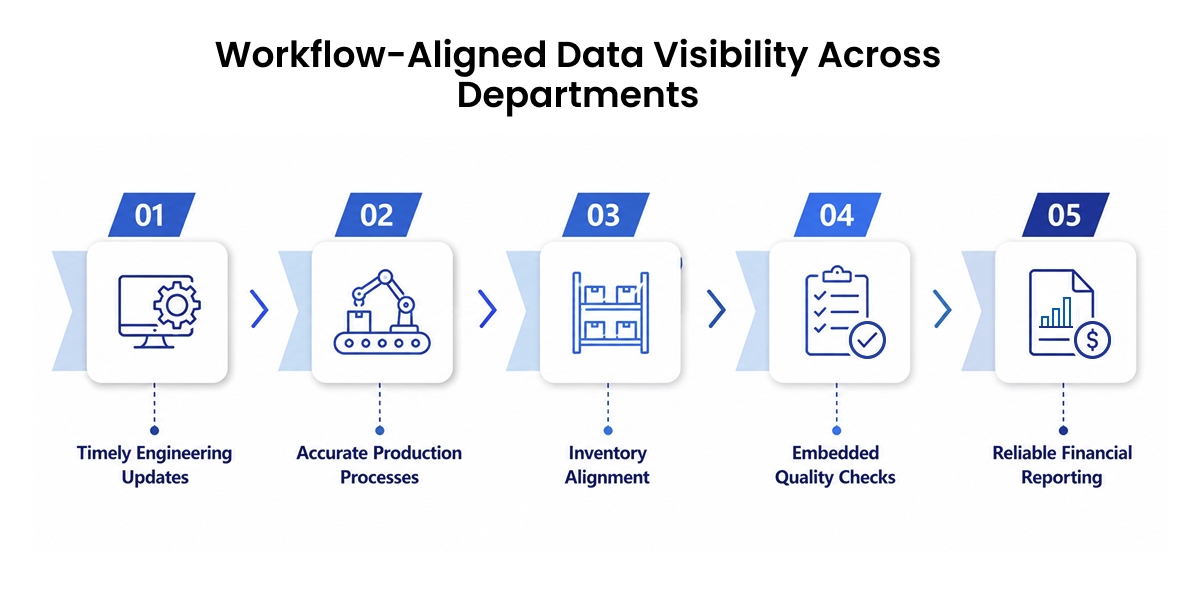
Scaling Workflow Systems As Discrete Manufacturing Grows
Growth, while desirable, can complicate discrete manufacturing workflows more than they already are. This can make scaling them effectively seem like a near impossibility, however, custom manufacturing software can help business owners unlock unlimited growth. Here is how:
- Managing multi-level assemblies and sub-assemblies
It is difficult to manage increasingly complex multi-level assemblies as the plant’s production capacity scales. The addition of each new level introduces new dependencies that must be synced across various production stages to maintain error-free continuity. Custom software can efficiently handle these dependencies, preventing them from turning into a limitation.
- Supporting multi-plant coordination and shared data
Expanding operations across multiple locations need a centralized system that ensures consistency of workflow and data throughout the various branches of the organization. Custom manufacturing software allows different plants to coordinate in real-time, improving reporting quality and production processes.
- Preventing workflow drift during rapid growth
Nothing leads to inconsistencies in workflow as rapid growth does. Each team is bound to adapt to evolving processes independently, leading to a disconnect between them. However, having a structured, centralized system can prevent drift and maintain alignment between operations and teams even as growth moves at an accelerated pace.
Real World Example: Custom Workflow System for Control Panel Manufacturing
At Vestra Inet, we have helped discrete manufacturers streamline their processes with our custom software. A leading example of that is Custom Control Panels Inc. – a Mississauga based manufacturer of custom electric, pneumatic, and electronic panels. Here is our custom manufacturing software helped them:
- Production workflow challenges before redesign
For Custom Control Panels Inc., managing their quotation and BOMs was getting increasingly complex due to their large client base. This, in turn, led to data chaos, making it difficult for the company to track the progress of its many orders while ensuring that each order was manufactured in accordance with exact client requirements. Furthermore, the company also needed software to track shipped orders.
- Outcomes after implementing structured workflow logic
Our custom software solutions helped Custom Control Panels Inc. automate critical tasks such as quotation and BOM management, thereby positively contributing to the company’s operational efficiency. Furthermore, the automation of shipping and delivery processes ensured every aspect of the company’s workflow was streamlined end-to-end.
Integrating Data Visibility Into Discrete Workflow Systems
The sheer volume of daily data a discrete manufacturing plant produces and deals with can be mind-boggling. Custom manufacturing software can organize large data sets and mine valuable insights from them, condensing them into digestible formats that stakeholders and leadership can use to their advantage.
- Real-time production data alignment with workflow stages
Custom platforms align production data with workflow stages to ensure insights generated reflect the plant’s operational realities. This improves data quality and supports better decision-making across all departments of the company.
- KPI tracking without manual reconciliation
Data capturing automation makes manual reconciliation redundant and unnecessary. This improves accuracy of the data available and also makes keeping a record of key information more efficient and less time-consuming. With workflow-driven software, manufacturers can consistently track important KPIs that align with their core production activities.
Common Mistakes When Implementing Workflow Systems
Implementing a workflow-driven custom manufacturing system is not without its challenges. However, common pitfalls can be avoided by being mindful of them and stopping them in their tracks as they arise.
- Overengineering the system before mapping workflows
It is critical to note that the discrete manufacturing plant’s individual, unique workflow should serve as the guiding principle for software design. That means its automation rules and system logic should be in tandem with the processes the company follows. This is possible when organizations carefully map their workflow and relay their requirements fully and transparently to software developers. Having a properly mapped workflow can prevent the creation of overly complex software that fails to serve its purpose.
- Relying solely on configuration instead of workflow redesign
Configurations, while an essential part of software, cannot solve the issue of broken workflows on their own. Effective workflow automation for discrete manufacturing hinges upon a complete redesign of processes the software emulates to ensure it aligns with the operational realities of the manufacturing plant.
Checklist: Implementation Mistakes To Avoid
Make sure to avoid the following mistakes during the implementation of workflow-driven custom manufacturing software solutions:
- Not accounting for exceptions
- Not validating shop floor reporting
- Not establishing clear data ownership at every stage
- Underestimating the role of change management
Conclusion: Why Workflow-First Design Defines Success
In discrete manufacturing, having workflow-first software is key to operational success. However, it can only be built on a clear understanding of the company’s actual operational realities. Aligning workflows and software can result in the creation of an efficient, transparent, and easier-to-control ecosystem that thrives even under the pressures of rapid growth and expansion.
Vestra Inet, one of Ontario’s leading software development companies with 20 years of experience, can help discrete manufacturers streamline their operations with its custom manufacturing software. Contact us to learn how our solutions support long-term growth and minimize operational risks.
FAQs
What does the workflow of a discrete manufacturing company look like?
The workflow of a discrete manufacturing plant follows a structured sequence of production steps that concern itself with the assembly of a particular product with the help of individual components that follow their own routing logic. It broadly encompasses three critical stages – planning, production, and quality control.
What are the seven flows of manufacturing?
The seven flows of manufacturing include material flow, information flow, production flow, quality flow, financial flow, supply chain flow, and customer flow.
How to make a manufacturing process flow chart?
The first step to creating an effective manufacturing flow chart is to map key production processes. Next, one should identify inputs and outputs at each stage as well as define the dependencies or exceptions between each stage to have a complete picture.
What is L1, L2, and L3 process mapping?
L1 process mapping provides a high-level overview of the whole structure. Meanwhile, L2 defines process flows, and L3 primarily concerns itself with task-level execution.
What should small and mid-sized manufacturers consider before implementing a workflow system?
Before implementing workflow-based software, small to mid-sized manufacturers must evaluate the complexity of their workflows, their growth rate, data integration requirements and existing tech stacks to clearly define what they need and want from the software.
Author Bio

Andrey Wool
Helming the operations at Vestra Inet, Andrey has over 20 years of leadership experience in the ERP industry. Having successfully launched 550+ software projects across a diverse set of industries, Andrey continues to transform the way businesses function with pioneering custom software solutions. His in-depth knowledge of sectors such as manufacturing and distribution has helped him curate actionable solutions that eliminate bottlenecks and pave the way for sustainable growth.
