
When Small Business Workflows Demand a Custom ERP Approach

|
In 2025, the value of Canada’s ERP software market stood at US $7,411.2 million, with the same expected to increase to US$14,901.8 million.
It is safe to say that options abound when it comes to ERP solutions in the country, with many of them making rather tall promises. However, only a handful of them deliver true scalable efficiency, visibility, and control across all a company’s departments – from sales and inventory to finance and operations.
For small businesses, having rigid software can be severely limiting. Especially when the goal is to be free of data silos. After all, spreadsheets are incapable of centralizing data and supporting growth, even if they serve as an inexpensive library of company data.
So what do you do as your company grows and exposes hidden gaps in your current workflows? Do you ditch the generic ERP train and hop onto the custom ERP bandwagon?
In this blog, Vestra Inet – developers of the most widely favored custom ERP in Ontario – will discuss why large-scale enterprise solutions are not the fix, and how custom ERP can actually support your organization’s growth goals.
What Custom ERP Means For Small Business Operations
When it comes to small businesses, custom ERP does not equate to piling up a list of features your company does not need. Rather, it is about taking a modular approach to ERP. The key is to design systems that actually revolve around your real workflows instead of trapping your business in the chokehold of rigid configurations.
Take, for example, the custom ERP solutions we develop at Vestra Inet. We begin by understanding the various processes your business hinges on – from sales intake to fulfillment and billing – before devising a fix for the gaps in between.
ERP configuration vs workflow-driven design
Let’s talk about how conventional ERP platforms work. They give you the ability to turn modules on or off and adjust built-in fields to suit predefined processes. While this might seem useful and intuitive in theory, the reality is different.
This kind of approach forces your team to mold their workflows according to what the software deems right rather than the other way round, thus rendering it ineffective in the long run. Custom ERP flips this script by embedding logic central to your business in its DNA so that approvals, handoffs, calculations, etc., truly reflect your company’s day-to-day operations.
Why enterprise models are not suitable for small business operations
To answer that, let’s think about your team. Most small businesses have small teams with members shouldering shared responsibilities while adapting to evolving processes. For example, your sales manager might be responsible for forecasting as well, while your operations staff handles purchasing and inventory.
Enterprise ERP does not allow this kind of fluidity. It features strict role separation and stable processes, which means it cannot handle the dynamic workflows of your growing company. However, custom ERP can offer support for flexible roles, truly tailored workflows, and incremental process maturity.
Where ERP Breaks Down In Small Business Workflows
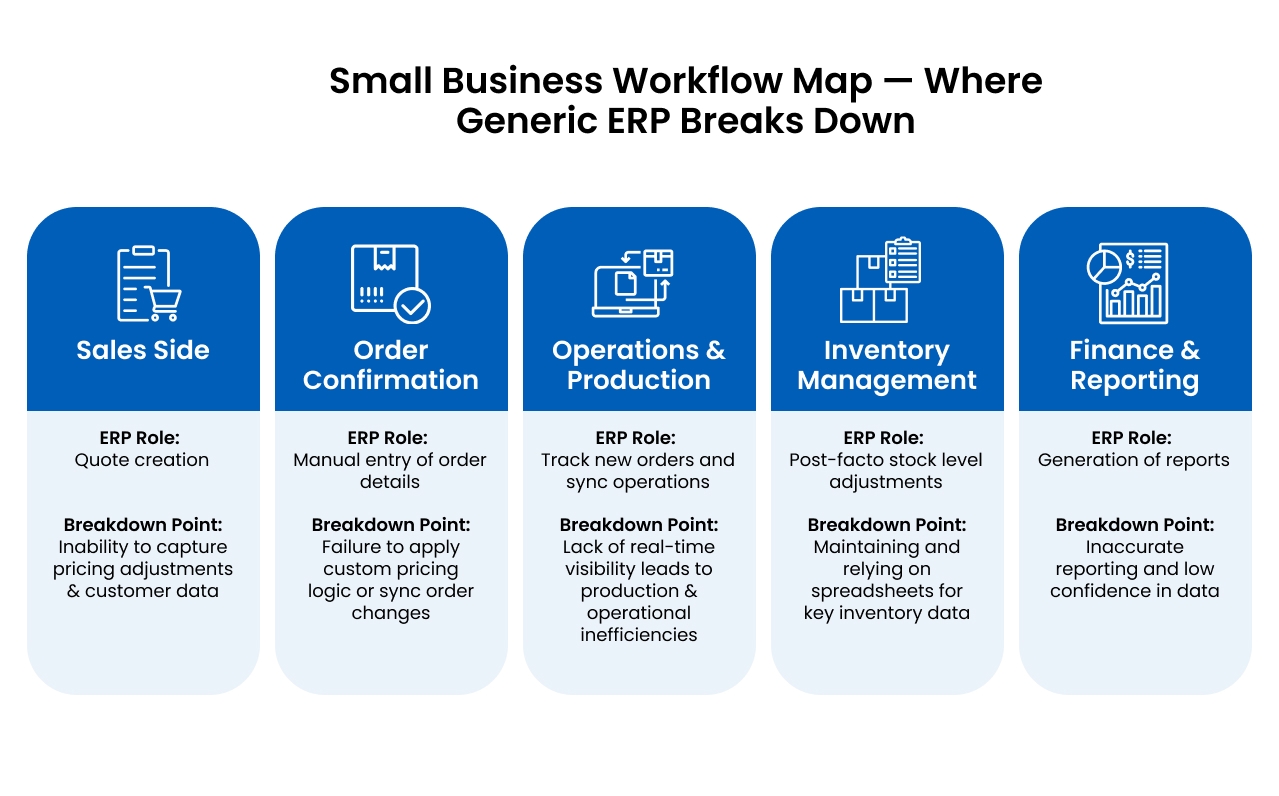
Cookie-cutter ERP tools are immensely helpful up to a point. Their inability to organize core company data is a glaring issue that becomes harder to deal with later on. As your business grows, this misalignment between the software’s features and how your business actually functions will keep increasing, resulting in a complete breakdown. Here’s where it most commonly occurs.
Sales to operation handoffs in lean teams
The sales and operations departments of small businesses tend to overlap. Standard ERP systems are built for segmented roles, structured approvals, and formal handoffs. They cannot adapt to the realities of your business, including cross-departmental functions, informal quote adjustments, or last-minute delivery timeline negotiations.
This inflexibility forces your team to look for inefficient workarounds such as spreadsheets, PDFs, and emails to update information, which can lead to the loss of critical data.
Disconnected finance, inventory, and production
When inventory tracking, financial data, and production planning do not talk to each other, chaos ensues. That is the problem with generic ERP – it is disconnected. That means you now have to resort to manual methods to adjust your inventory or reconcile costs after the fact. You may even be forced to use an entirely separate system to keep tabs on everything, which defeats the purpose of having an ERP to begin with. If your chosen software is turning inaccuracies and data silos into the norm, it’s a problem.
Root Causes Behind ERP Failure In Small Businesses
Don’t blame the software, blame the fit. Most ERP implementation projects fail because the chosen system is often a poor fit for the company. That said, other factors contribute to ERP failure, and these include:
Rigid systems designed for larger organizations
Traditional ERP assumes strict role separation and predictable approval chains. Any function that veers off this conventional path cannot be handled by them. However, small businesses need adaptability as their team members perform multiple functions at-once and the company’s processes are likely to evolve rapidly.
In such cases, the rigidity of traditional ERP can give rise to friction, forcing your team to work around it, thus undermining its value.
Manual workarounds, shadow processes, and spreadsheet reliance
Rigidity is the main culprit behind workarounds. When the ERP fails, spreadsheets take over tracking, emails replace approvals, and memos become the standard to capture exceptions.
While these quick fixes might be “effective” in the short run, they eventually lead to long-term issues such as fragmented data, inaccurate reporting, and decreased operational visibility.
That is why understanding where standard ERP fails is important. It gives you clarity about the issues and data gaps that custom ERP software can help you solve.
Operational Complexities Small Businesses Underestimate
As a key stakeholder in a small business, you know the inside story. You know its operations are anything but simple, even if they appear so from the outside. Growth can actually fuel complexity if it is not anchored by a formal process design. As a result, informal workflows that once made sense now fail to work. Here’s why:
Multi-role teams and unclear data ownership
When every member of your team dons multiple hats, a single person is likely to be responsible for sales, approvals, forecasting, and customer relationships. While this might be an efficient way to get things done, it can give rise to ambiguous data ownership.
This ambiguity works against the role assumptions and handoff clarity baked into generic ERP. The outcomes of this gap can range from delayed updates to inconsistent data, where none of your teammates actually know the current truth. As data loses confidence, it can force your company to regress back to manual methods.
Scaling volume without scaling process design
While you focus on scaling transaction volume, scaling process maturity can take a backseat – which means your current processes might not be able to handle increased orders and SKUs along with complex customer requirements.
When ERP systems process data but the decision logic stays manual, bottlenecks can creep in, forcing your team to resolve them with any means available. Remember, software alone cannot fix operational complexity. You need to have an intentional workflow design to achieve true efficiency as your business grows.
Why ERP Customization Alone Is Not Enough
Custom ERP is definitely a step in the right direction. But it has to be backed by a clear vision and a clearer workflow. Otherwise, the same problems are likely to persist. So instead of adding new fields or modules, focus on fixing your workflow first, so that the custom ERP can mimic it exactly, or you may have to face these problems:
Feature customization without workflow alignment
Internally, your teams might tweak the ERP you use by adding new data points, approval steps or reports. But none of these can fix the issue of an inefficient workflow. If the workflow remains unchanged, your team will still fall back on manual methods to get half the job done.
This can make ERP very hard to use. Not to mention fragile and slower to update, as each new feature can create dependencies that can be very costly to resolve. Especially for small businesses that do not have dedicated IT teams.
Long-term maintenance and process drift
Another major challenge is process drift. The workflow your company follows is bound to change as your business evolves. That means ERP customizations that once fit will now seem redundant. As a result, your team will go back to using manual methods, thus bringing down software-induced efficiency gains to zero.
Other challenges can follow this like a wave, including increasing maintenance costs, difficulty in implementing new upgrades, and being boxed into old processes that limit your company’s growth instead of supporting it.
That is why merely ordering custom ERP software alone is not enough. You need to ensure your chosen ERP’s logic is designed around real, clear workflows your company follows so the system can grow along with your business.
When Custom ERP Becomes A Business Requirement
For growing small manufacturing businesses, custom ERP software is a must-have. Here are clear signs that indicate you need to switch to better tools.
Signs, configurations, and add-ons no longer support operations
Warning signs will start showing early – long before your current system fails. For example, the heavy use of spreadsheets by your team is a major red flag. So is the need for manual reconciliation for accurate reporting. Moreover, if simple changes take weeks instead of hours, you know you have a problem. Lastly, data inaccuracy is another major sign your current system has lost the plot.
Designing ERP logic around real small business workflows
When the signs are this clear and strong, the only thing that can save your business is a custom ERP. By mapping and mimicking your real workflows, it can accurately capture how decisions are made, where roles overlap, and the exceptions that exist.
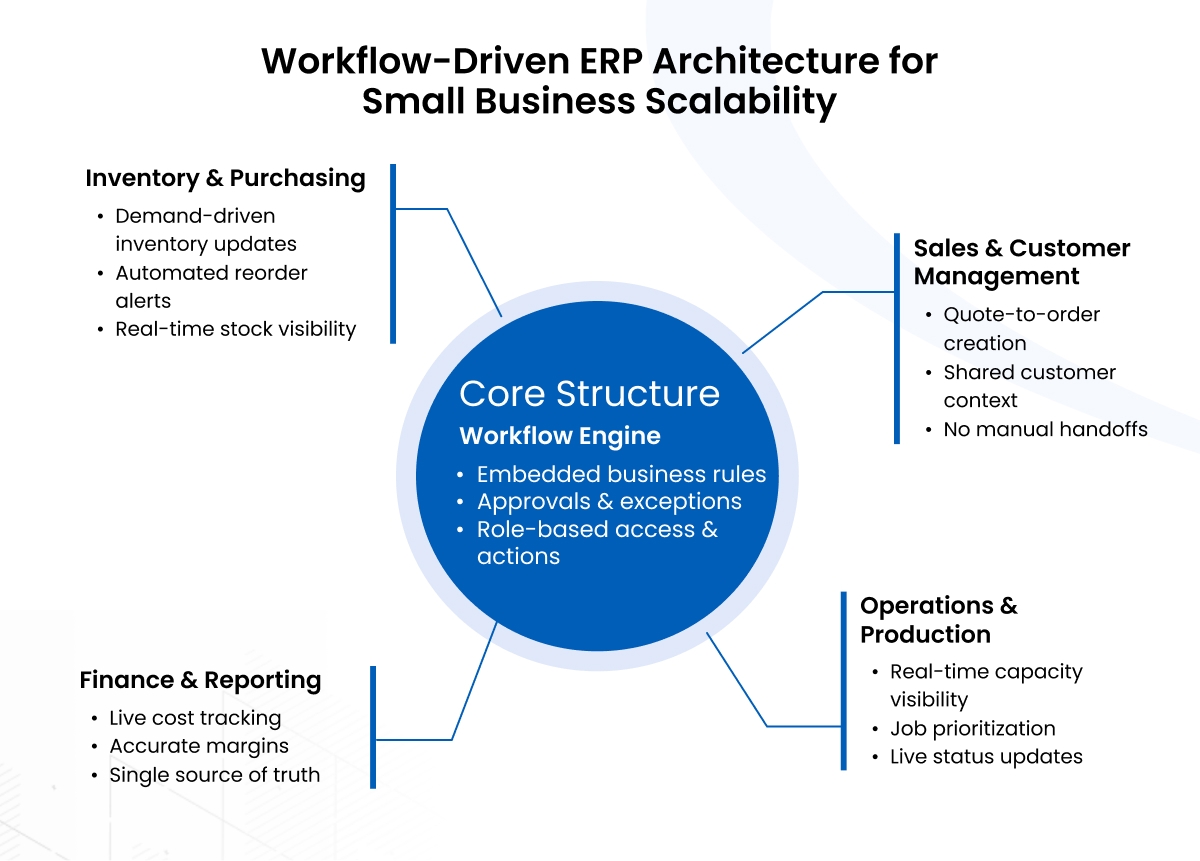
Instead of forcing your operation into a one-size-fits-all mold, it sets your business free to ensure sales and operations teams share context, finance reflects real-time numbers, and inventory and production can adapt dynamically to changing demands and order requirements.
Vestra Inet’s custom ERP systems do just that. It restores visibility by aligning all your processes and teams, and supports your company’s growth without sacrificing flexibility.
How Workflow-Driven Custom ERP Supports Sustainable Growth
There are many layers to how a custom ERP can help your business. However, what’s unchanged all across is that sustainable growth hinges on eliminating friction from your workflows. That is why it is critical to choose a vendor that takes a workflow-driven approach when developing a custom ERP for you. Just like we do at Vestra Inet. Here’s how it helps:
Aligns operations, finance, and reporting
Intentionally designed workflows enable the seamless transference of data across teams. Sales activity can influence operations in real time, while inventory updates can support accurate reporting. Furthermore, leadership gets a comprehensive overview into the real-time activities of their company via a single platform. This is a major win. Especially if you consider how it reduces delays and errors.
Reduces manual work while improving control
With a workflow-driven ERP, you can fully automate repetitive manual tasks such as approvals, handoffs, and exceptions while still maintaining the same level of flexibility your team is used to. The core advantage here is that you get stronger internal controls with fewer workarounds. This frees up your team’s time to deliver more value-driven work.
Scaling A Custom ERP System Without Over-Engineering
As a small business owner, your concern about ending up with an over-engineered custom ERP system – or rather a very complex software at an early stage of your growth – is valid. Fortunately, this can be avoided with a workflow-driven approach that focuses on adaptability and modularity.
Building modular workflows for future growth
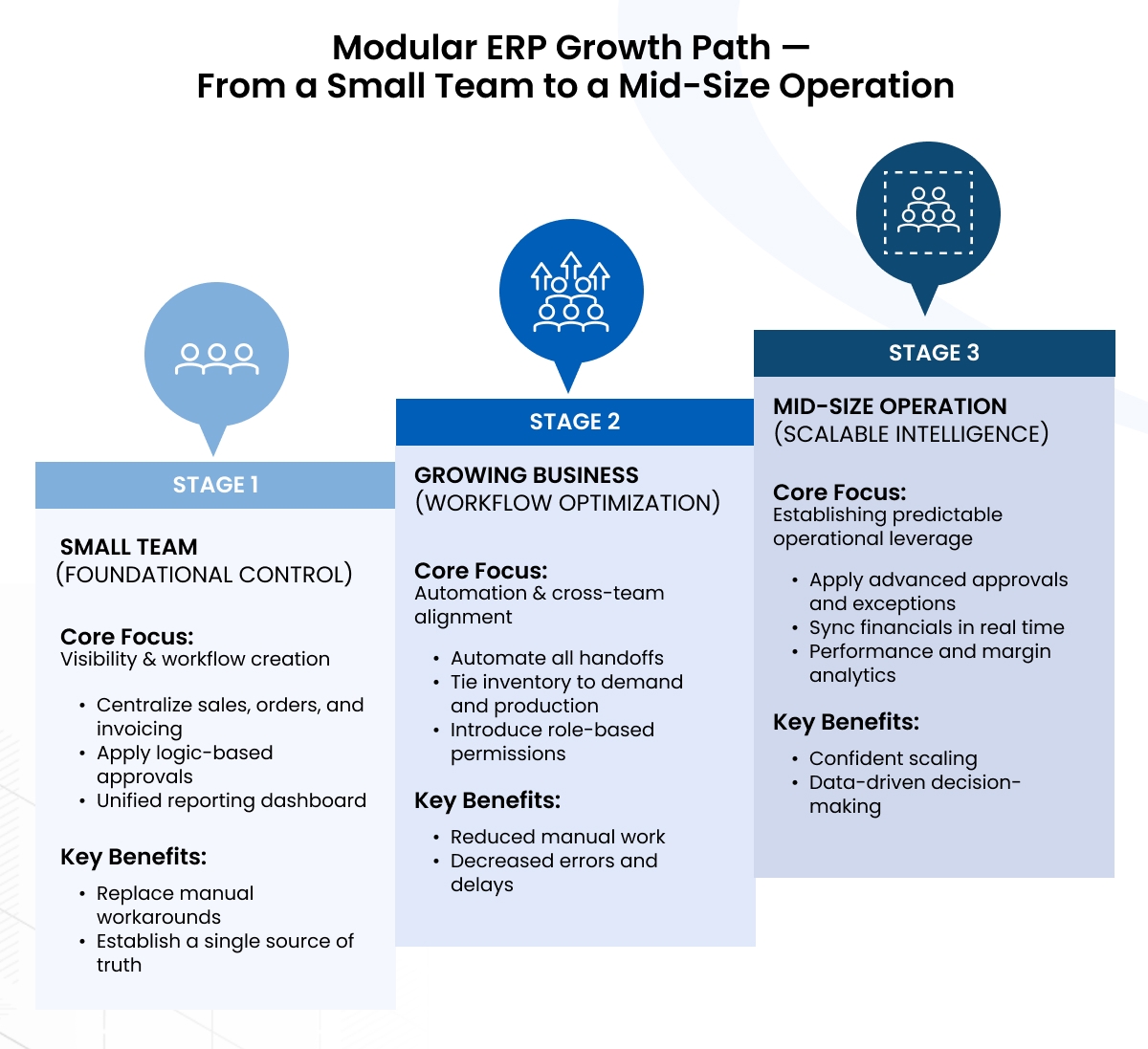
We cannot vouch for others, but at Vestra Inet, we do not build monolithic systems. The modules of our custom ERP are truly tailored to replicate your company’s real workflows – whether it’s sales intake, production scheduling, or invoicing. In fact, each of these processes is capable of evolving individually as your business grows.
Supporting change without system rewrites
As your business processes mature and take on a new shape, our modular ERP can mold itself around them without the need for a full rebuild. This kind of flexibility allows you to add new approval layers, reporting logic, or integrations in an incremental and non-disruptive manner. The impact of having such a system is increased user adoption.
Conclusion — Why Custom ERP Is About Workflow Control, Not Software
In the end, the success of custom ERP boils down to control, not the sophisticated nature of the technology behind it. You need a system that gives you complete control over how work flows, how data moves, and how decisions are made as your business reaches new stages of growth.
When ERP supports your workflows instead of dictating them (like generic software does), you achieve true clarity across all your teams – from sales and operations to finance and reporting. This, in turn, helps in the reduction of manual work, errors, and delays, allowing your business to scale without any operational constraints.
Next Steps for Small Businesses Considering Custom ERP
While defining your workflows is the first step on your custom ERP journey, the next step is to partner with a vendor that understands your organizational workflows and is able to build software around them.
Vestra Inet specializes in developing full custom ERP systems for mid-sized businesses that can be rolled out in incremental phases to ensure minimum disruption. We believe your Ontario business deserves an ERP that grows alongside it instead of staying behind. Talk to our workflow specialists to know how we can help you.
FAQs
What is custom ERP for small businesses?
For small businesses, a custom ERP system is a workflow-driven software that is designed around the business’s workflows rather than generic enterprise-level processes.
When should a small business consider a custom ERP?
If your current ERP is failing to keep pace with your company’s growth or if your processes are heavily reliant on manual input, you should switch to a custom ERP to gain maximum workflow efficiency.
Why do small business ERPs fail as the company grows?
The number one reason for their failure is that these ERPs are built on enterprise assumptions, such as fixed roles, strict handoffs, etc., that don’t align with lean teams and evolving operations.
Can a custom ERP replace existing systems gradually?
Yes. One of the major benefits of custom ERP is that it can be introduced in phases, which makes it easy to gradually replace existing systems.
Is custom ERP viable for small teams?
Absolutely. Workflow-driven custom ERP, in particular, is highly beneficial for small teams as it helps them reduce manual work while establishing data and operational clarity without increasing complexity.
Author Bio

Andrey Wool
Helming the operations at Vestra Inet, Andrey has over 20 years of leadership experience in the ERP industry. Having successfully launched 550+ software projects across a diverse set of industries, Andrey continues to transform the way businesses function with pioneering custom software solutions. His in-depth knowledge of sectors such as manufacturing and distribution has helped him curate actionable solutions that eliminate bottlenecks and pave the way for sustainable growth.
