
Custom Manufacturing ERP: Why Workflows Matter More Than Software
Key Takeaways:
Do not blame it on the software, blame it on misaligned workflows! The number one reason for custom manufacturing ERP failures, ill-defined workflows can break rigid systems. The fix? A workflow-first, custom ERP approach, which can help you restore:
- Visibility
- Control
- Scalability
Find out how it can help manufacturers with ETO, MTO, or job-based operations in this blog.
The tagline of almost every generic manufacturing ERP system in the market is the same: “An all-in-one solution that guarantees visibility, efficiency, and control”.
But how many of them actually deliver?
As an Ontario manufacturer, you know this promise sounds empty. Standard ERP tends to fall apart as soon as the system meets the shopfloor. So how can it be called an “efficiency engine”?
The problem with most generic ERP platforms is that they are built for static, linear workflows. The moment you introduce complexity or dynamism, their vast library of features becomes absolutely useless.
Since your business deals with variable BOMs, evolving designs, job-specific routing, and constant engineering changes, you need a system that can actually handle this level of dynamism. A platform that understands as well as you do how tightly knit your sales, engineering, production, inventory, and finance really are. A software that can put an end to the use of spreadsheets, emails, and manual workarounds once and for all.
That is where workflow-driven custom manufacturing ERP comes in. It fixes the workflow problem by mapping how your internal processes function across departments, which it then uses as the foundation to build a system that supports your ground organizational realities.
In this blog, Vestra Inet – Ontario’s leading maker of manufacturing software, will show you how a workflow-driven ERP is a real growth enabler.
How Custom Manufacturing Actually Works On The Ground
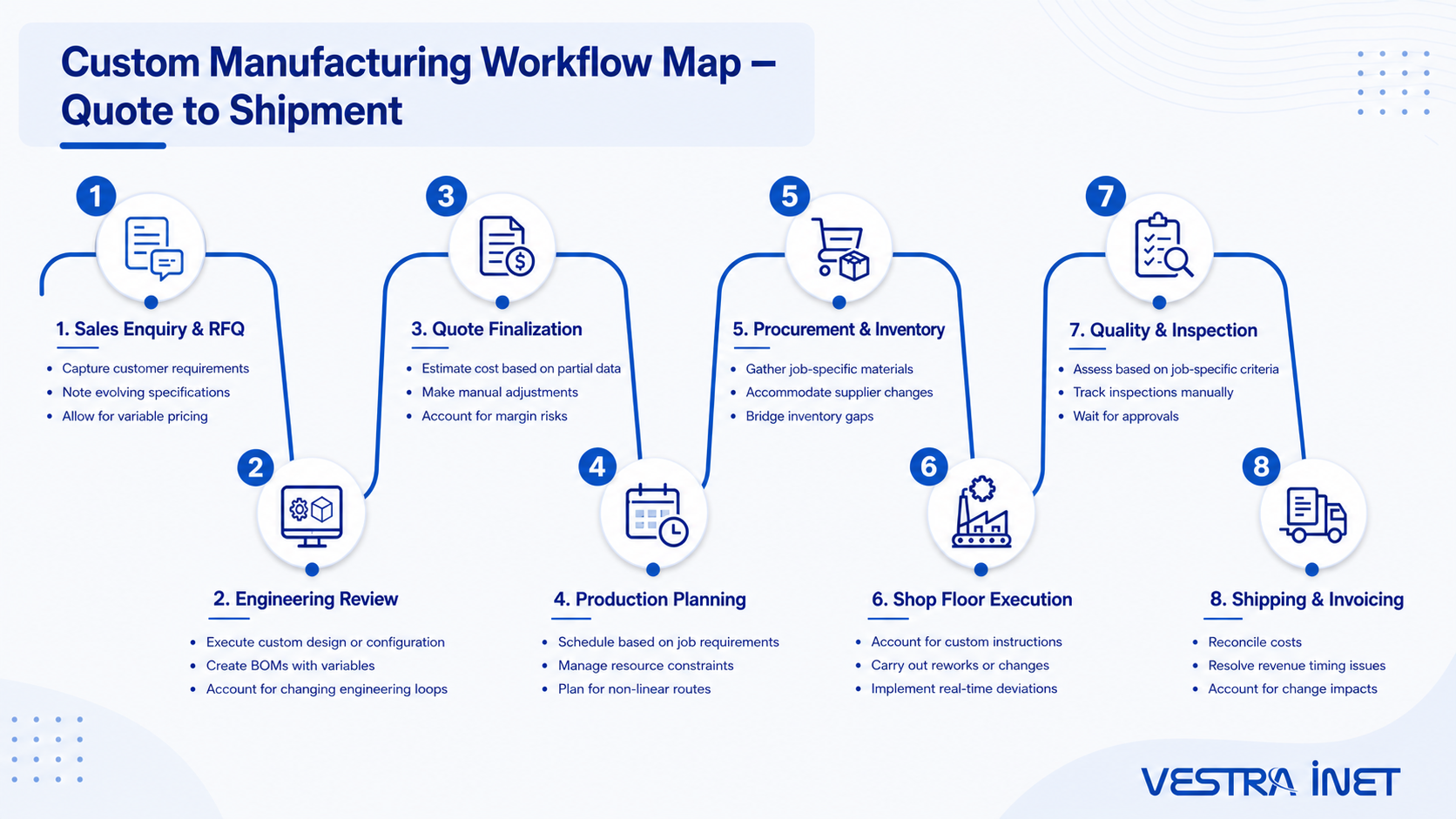
Custom manufacturing rarely ever follows a linear process.
Irrespective of your facilities' core model – Engineer To Order (ETO), Make To Order (MTO), or a mix of both – the process of manufacturing will always be dynamic, iterative, and completely reliant on the coordination between different teams.
The general path tends to begin with a customer inquiry that involves capturing their requirements, which are highly likely to evolve. Next comes the creation of quotes that the sales team builds after your engineering department determines the feasibility of the work order.
At this stage, BOMs are generally provisional, margins are estimates, and routings are still assumptions rather than a concrete reality. That is because even after the approval of the job and the commencement of production, engineering changes are likely to continue due to customer feedback, material availability or design refinements.
As for production planning, it takes a more job-based approach instead of a forecast-based one. That means schedules are not fixed and are likely to change as priorities shift, machines witness downtime, or resources are reassigned. The situation is no less dynamic for inventory and quality control, which are both likely to change on a per-job basis.
In all fairness, this is a highly complex and intricate workflow – especially if we factor in the constant flow of information across various departments. Handoffs cannot be super clean in such scenarios. And that’s not the only drawback. Context loss, laggy updates, and manual tracking are other major issues that can make standard ERP seem all the more redundant.
No wonder most businesses think of ERP as merely a “nice-to-have”, rather than a “must-have”. Rigid systems just do not provide the kind of flexibility and responsiveness companies need.
Where Traditional ERP Systems Break In Custom Manufacturing
One of the biggest problems with traditional ERP is that its assumptions do not match the realities of custom manufacturing environments. Standardized products, stable BOMs, predictable routings, and linear production flows might be the norm at large enterprises, but for ETO, MTO, and job-shop manufacturers, these expectations are points of failure.
Static BOM assumptions
Take the BOM stage, for example. That’s where breakdowns begin. Generic ERPs assume all BOMs are fixed and version-controlled, but those of custom jobs are likely to evolve as the engineering team refines the initial design based on feedback. Such changes typically arise mid-job, and cookie-cutter tools struggle to accommodate them, thus resulting in pricing errors and production delays.
Linear production planning mismatches
Production planning suffers, too, as ERP scheduling engines are programmed to handle repetitive manufacturing only. Custom orders, with all their variables, do not factor in. As a custom manufacturer, you have no option left but to override existing schedules and manually reassign work, which is both inefficient and hard to track.
Manual workarounds and data lags
When so many limitations exist, the flow of data across departments also suffers. Your sales team is forced to enter scope adjustments into spreadsheets because the ERP cannot handle it. Meanwhile, engineering teams revise specs on the fly and production has to modify its processes – both of which do not show up as updates on a traditional ERP, leading to invoices based on stale data and inaccurate WIP reporting.
Over time, these issues add up, reducing the role of generic ERP to a mere reporting tool rather than a real-time operational system. The software that was supposed to increase efficiency becomes responsible for introducing friction.
Despite its drawbacks, the software’s configurations or its users cannot be blamed. The deeper issue here is incompatibility. Traditional ERPs are not built to accommodate variables and feedback loops in real-time. Custom manufacturing ERP systems are meant for that.
Root Causes Behind ERP Failure in Custom Operations
The problem is not as simple as choosing the “wrong” software. ERPs in custom manufacturing fail simply because they are treated as a finished product from the get-go when they should be carefully engineered step-by-step to match your company’s real operational behavior. Let’s explore.
Process inversion
Most ERP implementation initiatives are geared towards getting teams to adapt to the software’s structure, rather than the software adapting to your team’s workflows. This is a counterproductive approach. In custom manufacturing, variable jobs, routings, and approvals are the norm. So boxing them into rigid structures can create friction instantly.
Misunderstanding of variability
Job-specific costs, engineering changes, and last-minute adjustments – each of these is a normal part of an average custom manufacturing plant’s operations. The problem with traditional ERP is that it assumes that preset configurations can control variability, but it’s not true. Rigidity only stokes the fire of manual intervention rather than dousing it.
Underestimation of cross-team coordination
Generic ERP treats each department as a separate module. But for custom manufacturing businesses, sales, production, inventory, engineering, and finance tend to overlap. Information flow and handoffs between them need to be seamless, or gaps can appear – again requiring manual intervention as a fix.
One has to remember that merely training their team in the ways of the new software is not enough to fix structural issues. While it might improve adoption, workflows will still remain misaligned, and long-term rigidity will stall a business’s growth.
The Hidden Complexity Of Cross-Department Workflows
Diagonal, backwards, forwards – the flow of work in custom manufacturing plants is seldom straight. Departments circle back to each other to maintain coordination, working in loops that cause traditional ERP systems to quietly break down.
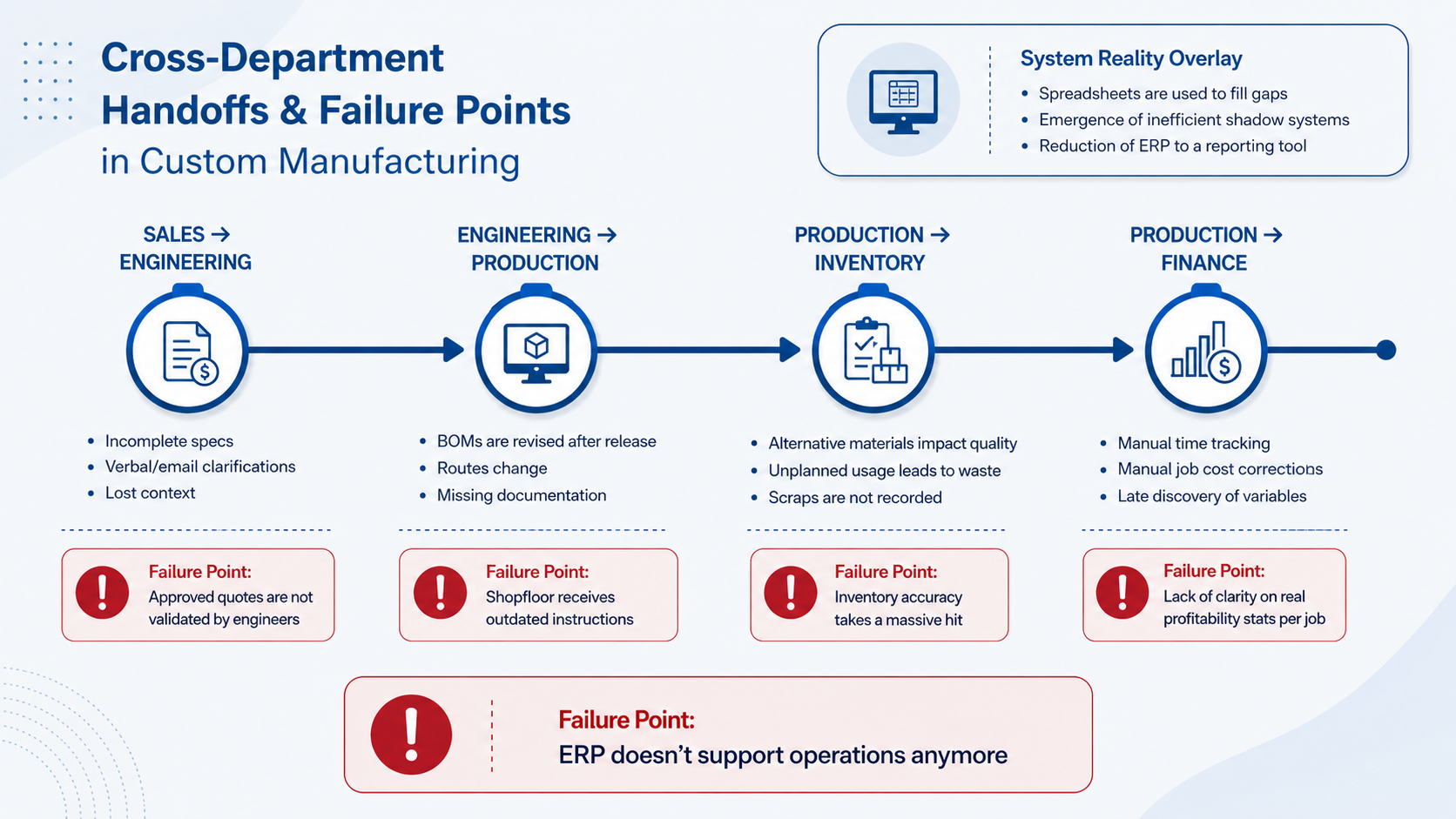
Sales to engineering translation gaps
The starting point of ERP breakdown is quotes. Quotes are rarely static. They evolve with changing specifications, assumptions, and feasibility of the job at hand. Areas of revision reveal themselves after countless customer interactions, but these do not find their way to traditional ERPs as they lock quote data way too early. As a result, engineering feedback is not updated in real-time, leading to misalignment.
Engineering to production misalignment
Custom manufacturing jobs often feature non-standard routings, alternative materials, and dynamic BOMs. Engineering changes need to reflect immediately on the shop floor or production teams invariably end up creating products with outdated specifications, leading to waste, rework, and scheduling issues – all thanks to a system that does not capture real-time updates.
Inventory visibility issues
In custom manufacturing, it is common to procure materials on a per job-basis rather than maintaining a fixed stock of parts or components. Unfortunately, traditional ERP systems rely on static inventory assumptions and are unable to capture material substitutions, last-minute additions, or partial availability, thus forcing the manual tracking of parts.
Production to finance reconciliation delays
Finance teams suffer just as much as the rest of them. That is because the accurate costing of a job depends on exact figures for labor, material, and time spent. Since generic ERP does not update either of them in real-time, there is no clarity on the exact value of each of them. This turns financial reporting into a guessing game, and we all know how negatively that can impact the revenue of a company.
As if this picture was not blurry enough, what makes things worse is that each of these issues is not visible in isolation. Your team might be continuing to use the software correctly, but since it does not fit your overall workflow, fractures will silently appear. That is why centralizing handoffs with a system designed to work around your company’s workflows is critical.
When Custom Manufacturing Needs Custom Software
By now, you know that the system of manual workarounds combined with a rigid ERP will only take your manufacturing business so far. Sooner or later, this system will reach its tipping point, forcing you to reevaluate your operational strategy from the ground up. That’s where custom software can save the day.
Unique workflows that cannot be configured
This is one of the most obvious signs you need custom software. Engineer-to-order environments are rarely linear. Jobs might change direction mid-production, pause, or expand. If your ERPn system is forcing these realities to fit into rigid sequences, it is time for a change.
Non-standard routing and approvals
Being a custom manufacturer, you know just how critical job-specific routing logic and conditional approvals are. Exception-based flows lie at the core of your business. So how can spreadsheets, emails, and verbal communication be used to handle all of them when an ERP system exists? The very fact that your software is failing to act as a single source of truth is a major sign.
Job-specific costing logic
To reiterate, standard ERP operates on fixed assumptions when it comes to material usage and labor patterns. But custom manufacturing orders are not like that. Even if a client places a similar order, its specifications still will not be able to fit into predictable molds. So if your team cannot accurately capture variables, feed them into the system, and reap the benefits of automatic updates, you know your current tool is no longer working for you.
Real-time production feedback loops
Real-time visibility into the progress, constraints, and changes of each custom work order is a must-have for any manufacturing business. It is what helps you make informed decisions about resource allocations, scheduling, and more. However, if your system lags behind reality, the decisions you end up making will be too little, too late. The result? Eroding margins due to intuition-based decisions rather than information-based ones.
All of these signs clearly indicate that your company needs a solution that mimics its unique workflows. Custom software takes a workflow-first approach, allowing you to clearly define your company’s processes first so its core features can be modelled on them.
What A Workflow-First Custom Manufacturing ERP Looks Like
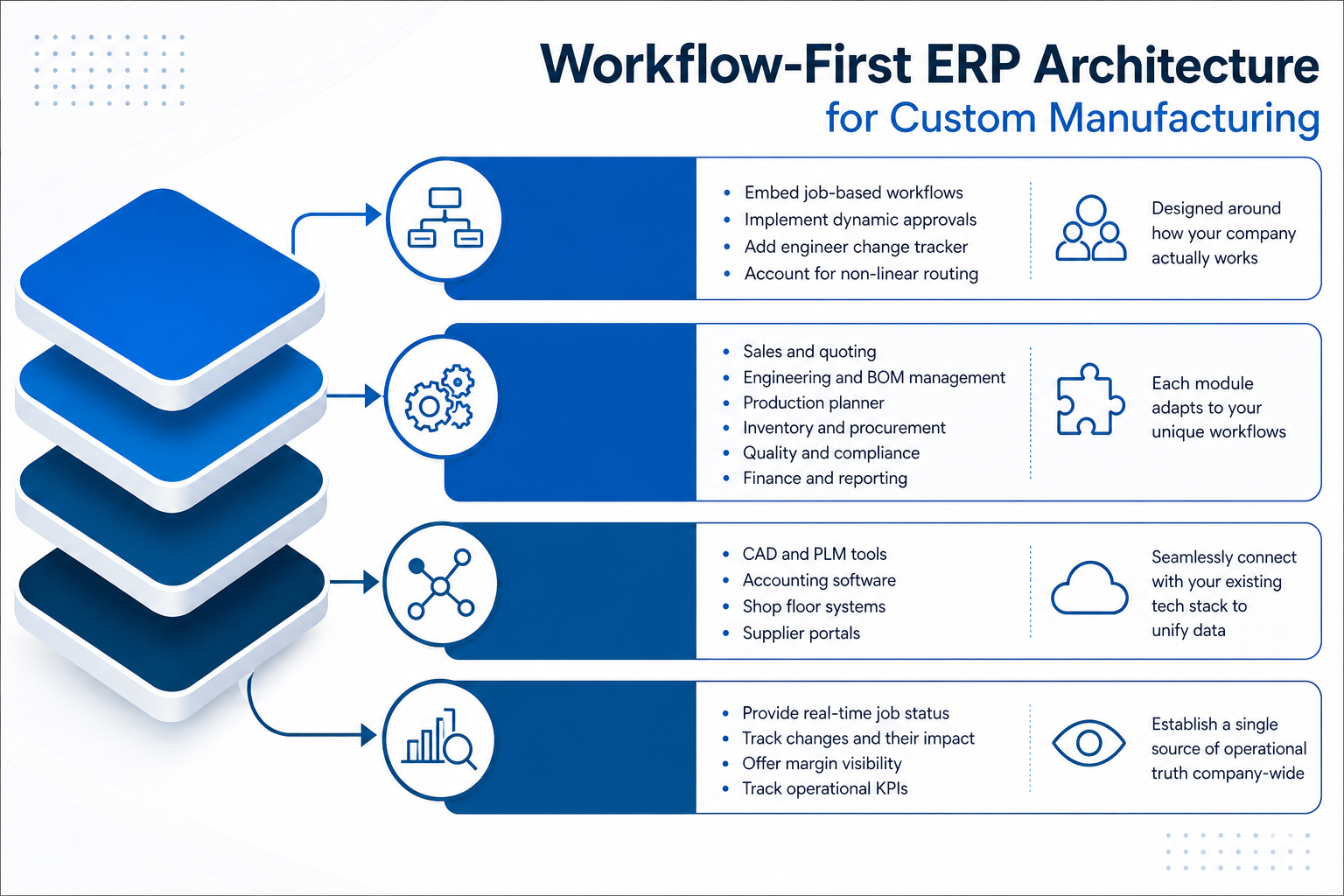
While specific modules for specific functions lie at the core of a manufacturing workflow software, they are not the starting point. That title goes to how work actually flows across your organization. The entire system’s logic will be built on your company’s unique processes. Here are central features you can expect:
Process-driven system design
Static BOMs and linear production paths are not custom ERP features. Instead, variability forms the basis of its design. So, for example, any engineering change that arises will not be treated as an exception. It will be considered the norm, so it can be tracked dynamically. Furthermore, approvals will be triggered on a context basis, so you get to work with a truly flexible system that mirrors your operational behavior.
Modular workflows
Custom ERP makes handoffs feel effortless. Every job moves through a well-defined yet highly flexible workflow that accounts for exceptions without manual intervention. You can shape this workflow anyway you want. For example, sales could feed data to engineering, engineering could update production, and so on and so forth. This level of modularity makes it easier to scale complexity as your production grows.
Flexible data models
For custom manufacturers, keeping tabs on job-specific variables, conditional logic, alternative materials, and real-time changes is critical. Custom software allows you to do that without breaking the system’s integrity.
Integration with existing tools
Shopfloor workflow integration is important for any manufacturer, and workflow-driven ERP makes it happen. You do not have to rip out any of your existing tools and swap them with new ones to maximize compatibility. Custom systems are designed to connect to your company’s CAD, accounting, supplier, and shopfloor software.
What you get is not just “better” software. You get complete operational clarity, thus making custom ERP a growth accelerator rather than a constraint.
How Custom Workflow Engineering Reduces Operational Risk
Since custom manufacturing processes are different, how can the software meant to handle them be generic? The good thing about applying workflow engineering to custom software is that it mitigates operational risk to a large extent. It weeds out ambiguity top to bottom to result in the following benefits:
Fewer manual handoffs
One of the most effective ways in which custom ERP software reduces operational risks is by decreasing the number of manual handoffs that happen within your organization. System-driven workflows make it easier to capture sales assumptions, engineering revisions, production constraints, and cost impacts accurately on a single platform, thus minimizing miscommunication.
Improved traceability
Traceability can only improve with intentionally engineered solutions. Custom systems track every single change – whether it concerns designs, materials or everything in between. Updates are instantly visible and accessible across teams, thus decreasing instances of quality or compliance issues.
Faster change adaptation
Production processes can change fast, making the environment of a custom manufacturing plant highly dynamic. Workflow-driven software can keep up with this pace, quickly adapting to engineering changes, supplier delays or production issues – all thanks to its conditional logic.
Improved decision-making
Finally, the real-time visibility tailored systems provide can instantly improve decision-making. Leadership no longer has to rely on outdated data or wait for end-of-month reports to understand bottlenecks and margin risks. Instead, the provision of accurate and current data makes sure you can address issues before they become expensive problems.
By engineering your workflow first, you give custom software the features it needs to bring down operational risks and increase transparency and resiliency instead.
From Workflow Design To Working System
At Vestra Inet, we are pros at designing workflow-driven software for custom manufacturing businesses in Ontario. We have created advanced solutions for several of our clients but one of them stands out.
We are talking about Siltech – manufacturers of chemical solutions in Toronto who specialize in making organo-functional silicone compounds and resins. They needed software to streamline their entire manufacturing process and we made it happen by taking a smart and calculated approach.
We started with discovery and process mapping to understand exactly how their chemical manufacturing process functions. Next, we moved on to architecture design, wherein we engineered a workflow-based system that actually supports job-based logic, flexible routing, and dynamic approvals.
Next, we took an iterative approach to determine the feasibility of the software, testing and validating every single one of its modules and features against the company’s real operational scenarios. Finally, once testing was over, the software was ready for adoption and refinement. Feedback from Siltech’s team helped us fine-tune its modules so they worked as expected.
You can learn more about how we helped Siltech here.
Why Custom Manufacturing ERP Is A Strategic Investment
By now, you know there are many reasons to adopt custom manufacturing operations software. That said, here’s a brief round-up of the most valuable arguments in favor of custom ERP being a strategic investment:
Scalability without re-platforming
Re-structuring your entire workflow to scale operations is not a fruitful experience. It only slows your team down and leads to data chaos. With custom ERP, you do not have to resort to replatforming to scale every time your company witnesses growth. It's built to scale automatically.
Alignment with how teams actually work
Since the entire system is engineered around real operations, you get to experience full alignment – even as production volume grows or products diversify or processes evolve. You also get the option to add new logic without altering existing workflows.
Long-term operational resilience
With real alignment comes long-term operational resilience. Not only does the system earn your team’s trust, but it also gives your company’s leadership access to accurate data. The result? Faster decisions, zero breakdowns, and proactive manufacturing.
If you add these up, you will see that custom ERP is not an expense. It is an investment in your company’s scalability and stability.
Conclusion: Building The Right System For Custom Manufacturing
For custom manufacturers, workflow should be the starting point of their custom ERP journey. Establishing a clear workflow can help you design software that mirrors how jobs move, where handoffs happen, and how information flows across your teams. This prevents misunderstandings while giving you full control over your operations.
Want to get started? Vestra Inet is Ontario’s leading custom ERP software development company. Our ERP does not force your operations into a monolithic structure. It gives you the flexibility and control you need to scale comfortably. Contact us to get software that reflects your operational realities.
FAQs
Why do manufacturing ERP implementations fail?
The number one reason behind their failure can be attributed to the configuration of the software around generic assumptions that do not match the real-world workflows of the company.
When does an ERP need to be custom-built?
Resorting to custom ERP is a must if your company’s existing software and tools no longer support job-specific workflows, engineering changes or cross-departmental coordination.
How do workflows impact manufacturing efficiency?
The impact of workflows on a manufacturing ERP’s efficiency can be witnessed via reduced handoffs, elimination of data duplication, and real-time visibility.
Can a custom ERP integrate with existing systems?
Yes. Especially, if you get your workflow-driven ERP from Vestra Inet as we equip our software with APIs that allow for third-party software integration, whether it’s CAD, accounting, or inventory platforms, among others.
Author Bio

Andrey Wool
Helming the operations at Vestra Inet, Andrey has over 20 years of leadership experience in the ERP industry. Having successfully launched 550+ software projects across a diverse set of industries, Andrey continues to transform the way businesses function with pioneering custom software solutions. His in-depth knowledge of sectors such as manufacturing and distribution has helped him curate actionable solutions that eliminate bottlenecks and pave the way for sustainable growth.
