
Closing Workflow Gaps: A Smarter Approach To Manufacturing Operations Management

Key Takeaways:
The major contributors to manufacturing workflow gaps include:
- Disconnected systems
- Delayed communication
- Fragmented operational visibility
A custom manufacturing workflow management system is key to improving cross-departmental coordination and enhancing processes such as planning, production, inventory management, and reporting. It effectively removes bottlenecks and supports scalable operations.
Did you know Ontario is home to 37,550 manufacturing companies? Together, they employ nearly 800,000 people! These numbers are set to grow, underscoring the need for effective manufacturing operations management so companies can expand without incurring productivity or profit losses.
However, expanding operations often introduces new roadblocks – especially as rudimentary systems fail to keep up. Over-reliance on spreadsheets, emails, and other informal methods of coordination creates visibility gaps that halt production and adversely impact decision-making.
Furthermore, disconnected systems and inaccurate reporting create blind spots, which can have a top-down impact on manufacturing, throwing scheduling, inventory, production, etc., off balance. That is why it is important to have an operations management system in place.
In today’s blog, Vestra Inet, developers of custom software in Ontario with 20 years of experience, will explore how software can fix the workflow gaps in manufacturing operations management.
What Manufacturing Workflow Management Actually Includes
At the ground level, manufacturing workflow management is a lot more complex than it looks. It follows a non-linear flow that jumps between coordination, handoffs, and execution.
Coordinating production, inventory, and operations workflows
Serving as the starting point, these seemingly simple tasks have their own complexities baked right in. For mid-sized manufacturers, syncing production schedules, available stocks, material movement, labor allocation, and operation approvals is critical for efficiency. Lags in any one of these aspects can cause delays to cascade all across the workflow.
Managing approvals, handoffs, and production status updates
Production workflow management doesn’t stop at communication. It depends on approvals and cross-departmental handoffs as well. Engineering and production teams must work together with the quality department to ensure revisions, confirmations, and inspections are accounted for. A centralized manufacturing workflow ensures timely delivery of critical updates, thereby preventing chaos.
Connecting planning, execution, and reporting activities
Real-time flow of information between planning and production systems is an essential part of shop floor workflow optimization for manufacturing companies. From supervisors to managers, every single department head relies on accurate production data to make smart decisions at various stages of the manufacturing process. That’s why access to reports that accurately relay shop floor activities is crucial.
Where Manufacturing Workflow Gaps Typically Appear
Complexity is built into a typical manufacturing workflow. If this complexity is not tackled by the company’s operations management system, workflow gaps can creep in.
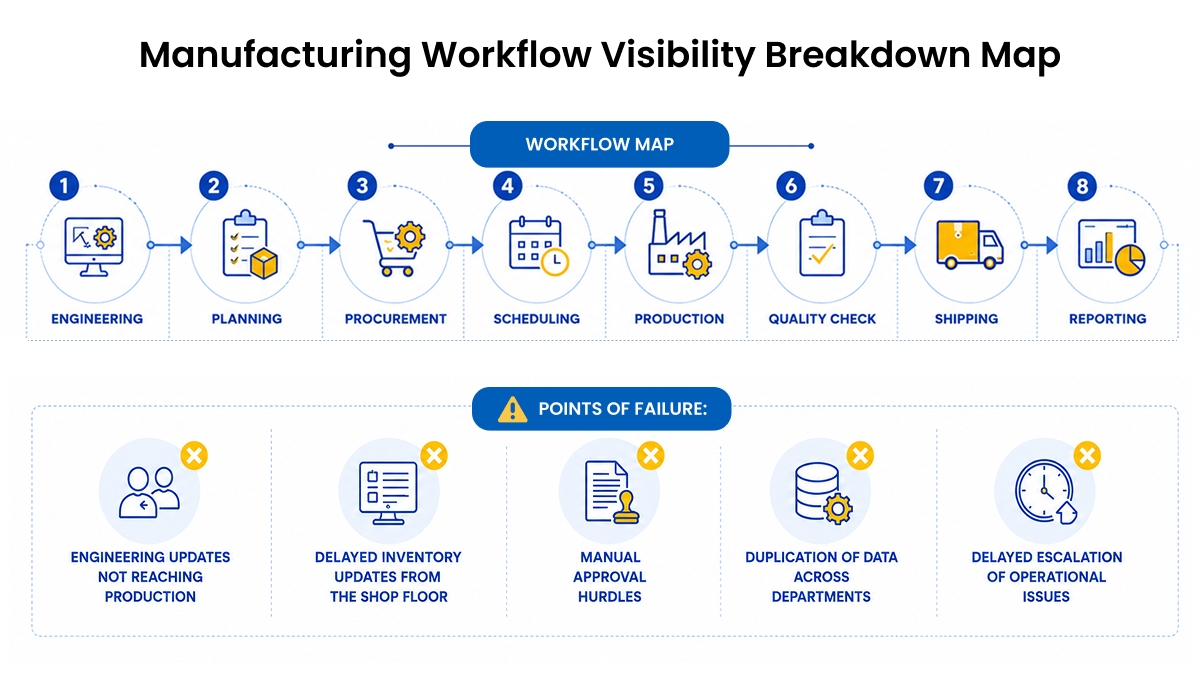
Engineering to production communication breakdowns
Lack of coordination between these two teams is the natural outcome of using disconnected systems to manage operations. Engineering teams may revise or update drawings and may make changes to the specs of a product, which often fail to reach the shop floor in time. Production teams are left working with outdated data, leading to material waste and delays.
Inventory and shop floor synchronization failures
The same happens when inventory and the shop floor do not sync with each other. Stock levels can impact production volume and speed, and vice versa. This makes tracking work-in-progress inventory extremely difficult, leading to reduced visibility across operations.
Delayed approvals and production bottlenecks
Operational approvals, quality checkpoints, and scheduling confirmations are the pillars upon which the smooth functioning of a manufacturing company rests. However, approval delays and production bottlenecks can force teams to create manual workarounds outside official systems, just to keep production moving.
Root Causes Behind Workflow Failures in Manufacturing Operations
Miscommunication is not the only reason behind manufacturing workflow failures. The following are just as major causes:
Fragmented systems managing isolated workflow stages
Having separate tools to manage scheduling, inventory, production, etc. is far from ideal. While each system might work well independently, they tend to work in isolation. The lack of coordination between them creates operational blind spots and delays.
Workflow logic designed around departments instead of operations
Generic software follows a manufacturing template that it tries to enforce on all organizations, even if their operational realities are chalk and cheese. When using such tools, departments are left with no choice but to optimize their own processes independently without any regard for cross-departmental interactions, leading to workflow failures.
Human workarounds replacing standardized processes
Since existing software does not support operational realities, employees naturally turn to manual workarounds to keep production afloat. As a result, spreadsheets, whiteboards, and verbal updates and approvals become the standard mode of communication. This creates visibility gaps and operational inconsistencies.
Why Generic Workflow Systems Fail in Manufacturing Environments
The truth is, generic software is not even as affordable as it seems. In the long run, it is more likely to cost more, not just in terms of licensing fees, but also in terms of cost incurred due to productivity loss. Here’s why they fail more often than not:
Static workflow logic versus dynamic production operations
Dynamism is the defining characteristic of manufacturing environments. But generic systems are incapable of accommodating that. Their rigid workflows cannot incorporate changing production schedules, engineering revisions, customer demands, or any other such variable. This causes workflows to disconnect from operational realities.
Workflow exceptions that cannot be standardized
Standardized workflows are not the model that manufacturing companies follow. Most organizations, in fact, have to regularly deal with scenarios such as rush orders, machine downtime, quality issues, and production changes, which make their workflow very fluid. However, cookie-cutter tools cannot handle these exceptions, leading to manual workarounds.
Why manufacturing workflows require operationally aligned systems
Effective production workflow management reflects how a manufacturing company actually functions. That’s why it’s only a matter of time before manufacturers learn that disconnected tools do not match operational truths. What can adapt to real production complexity is custom manufacturing workflow software. It aligns workflows with actual production movement while being flexible enough to accommodate exceptions.
Designing Workflow Management Around Real Manufacturing Operations
For a lot of manufacturers, the purpose of custom software is merely automation. That couldn’t be further from the truth. Automation alone cannot fix disconnected processes, support workflow exceptions, or fix data accuracy issues. Instead, it goes a step beyond and uses the following as its foundation to evolve into a system that eliminates all bottlenecks:
Mapping real production movement before system design
For manufacturing workflow management software to work, a strong understanding of how the company actually carries out its processes is essential. This knowledge helps in the development of a system that follows the business’ unique routing paths, production dependencies, approval requirements and communication flows.
Aligning workflow stages with operational dependencies
Production workflows are complex. Shared dependencies between engineering, procurement, scheduling, inventory, quality control, and shipping mean the journey a product takes is rarely linear.
That said, a well-designed system will reflect these dependencies instead of forcing operations into simplified process templates.
Alignment with real production activity is critical. In fact, many businesses have already learned through experience that traditional ERP does not offer the flexibility they need. That’s why most of them have adopted a workflow-first custom manufacturing ERP strategy to maintain perfect alignment between operational logic and manufacturing realities.
Building escalation and exception handling into workflows
Structured escalation and exception management should be built into the software's DNA to eliminate any scope for manual workaround.
Key events such as production delays, inspection failures, machine downtime, and engineering changes must automatically trigger appropriate operational responses so the situation can be dealt with promptly.
Clear built-in escalation paths ensure issues are resolved before they turn into full-blown operational emergencies.
Improving Shop Floor Visibility Through Workflow Coordination
Workflow coordination results in stronger collaboration between departments, which is the ultimate secret to manufacturing efficiency. While verbal communication is obviously central to this, shop floor visibility also receives a major boost when the software used is built to harmonize various processes:
Real-time production tracking aligned with workflow stages
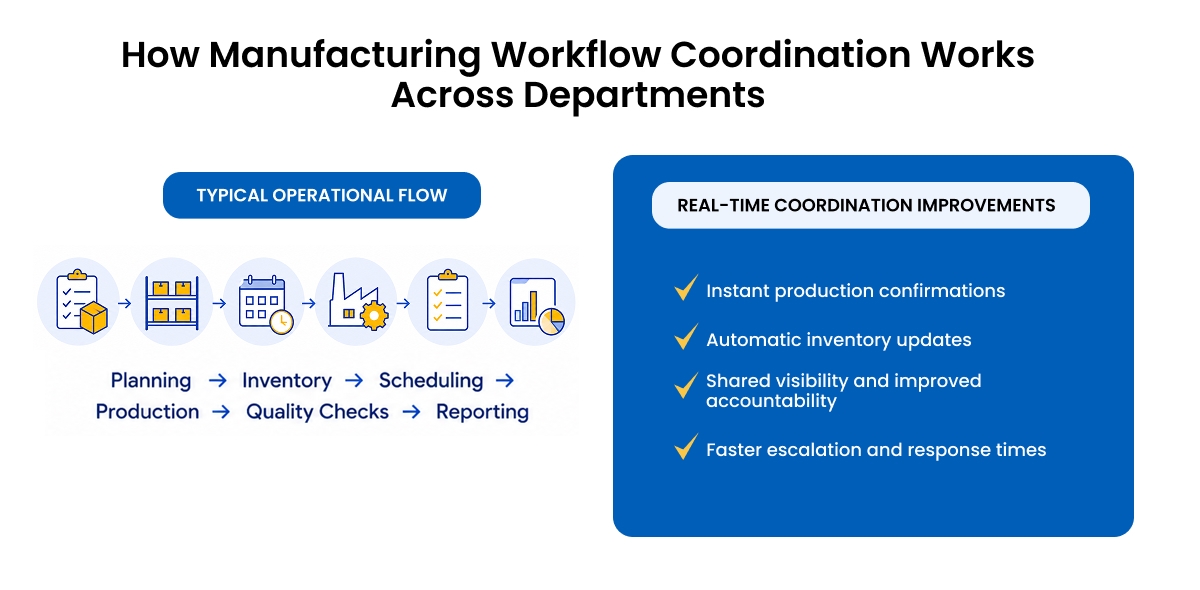
When production tracking syncs with workflow stages, visibility improves automatically. As a result, operators, supervisors, and production planners get to work from the same production data that reflects the realities of the shop floor. Reporting delays and operational blind spots are reduced to the bare minimum.
Coordinating inventory, scheduling, and production status updates
Every single manufacturing operation, irrespective of its size or volume, needs access to reliable inventory data to move as planned. Custom software ensures that production updates can automatically trigger adjustments to inventory levels and schedules so they are accurate and easy to work with.
Reducing operational blind spots across teams
Disconnected reporting is not just inaccurate; it’s a creator of operational blind spots that lead to weak decisions and poor workflow accountability. Integrated shop floor software reverses this by clearing data fog, improving visibility, and enhancing decision-making across the board.
Scaling Workflow Management as Manufacturing Complexity Increases
One of the major points of concern for most manufacturers is whether their chosen software has what it takes to scale alongside their operations. It’s possible – with Vestra Inet’s custom manufacturing software.
Support for multi-line and multi-plant operations
Vestra Inet’s software can accommodate expanding operations without breakdowns, hiccups or lags in performance. With its scalable manufacturing workflow automation feature, it ensures operational consistency even as companies grow.
Prevent workflow drift during operational expansion
Informal workflows are often born out of the need to keep up with rapid growth. That’s not the best way to manage increasing demands. Vestra Inet’s software connects disconnected processes to prevent workflow drift and improve operational coordination.
Manage workflow consistency across teams and shifts
Unlike generic software that uses templatized workflows, our platform standardizes company workflows while being flexible enough to account for escalations and exceptions. This consistency ensures growing manufacturing environments remain efficient. It also enables greater operational control and visibility.
Case Study: How Vestra Inet Helped A Growing Manufacturing Company Improve Its Workflows
Having 20 years of experience in software development, we can tell when a company is struggling to make ends meet with its current system. One of our clients, Siltech – a chemical manufacturer based in Toronto, was in the same boat. With two large-scale facilities equipped with several tools and tanks, managing production and inventory was a nightmare.
Vestra Inet stepped in with its custom manufacturing software to help Siltech manage its production schedule and inventory across its locations in a more efficient manner. Our workflow-based approach improved visibility into the company’s planning, scheduling, inventory, and production operations. It also reduced manual dependencies and ensured greater operational control.
Conclusion
Workflow visibility depends on the system’s ability to mirror real operations. If they do, data reliability and accuracy improve. This enhances the efficiency of various processes, including scheduling, inventory, and production, among others. Long-term scalability also improves with custom software as complexities and growth pains are accounted for without adversely impacting coordination.
Manufacturers that need custom workflow-driven software need to partner with the right vendor to get a system that actually works. Vestra Inet specializes in designing and delivering custom software that meets the demands of Ontario manufacturers. Contact us to get systems that eliminate blind spots and delays to restore efficiency, visibility, and accuracy.
FAQs
What is manufacturing workflow management?
Manufacturing workflow management is a process that focuses on improving coordination between various functions and departments such as production, inventory, scheduling, and approvals to ensure operational efficiency.
Why do workflow gaps happen in manufacturing operations?
Disconnected systems, manual coordination, delayed reporting, and poor inter-departmental communication are responsible for introducing workflow gaps in manufacturing operations.
How does workflow automation improve manufacturing efficiency?
Workflow automation improves production visibility, scheduling accuracy, operational coordination, and reporting consistency for manufacturing companies.
Can workflow systems integrate with existing manufacturing software?
Yes. Advanced workflow-driven custom software designed by Vestra Inet is capable of integrating with a host of other platforms, including ERP, MES, inventory, scheduling, etc. This ensures data consistency and operational visibility.
What should manufacturers evaluate before designing workflows?
Before redesigning their workflows, manufacturers must map their current processes, identify bottlenecks, evaluate production dependencies, and assess manual handoffs and approvals to support the development of truly customized software.
Author Bio

Andrey Wool
Helming the operations at Vestra Inet, Andrey has over 20 years of leadership experience in the ERP industry. Having successfully launched 550+ software projects across a diverse set of industries, Andrey continues to transform the way businesses function with pioneering custom software solutions. His in-depth knowledge of sectors such as manufacturing and distribution has helped him curate actionable solutions that eliminate bottlenecks and pave the way for sustainable growth.
